
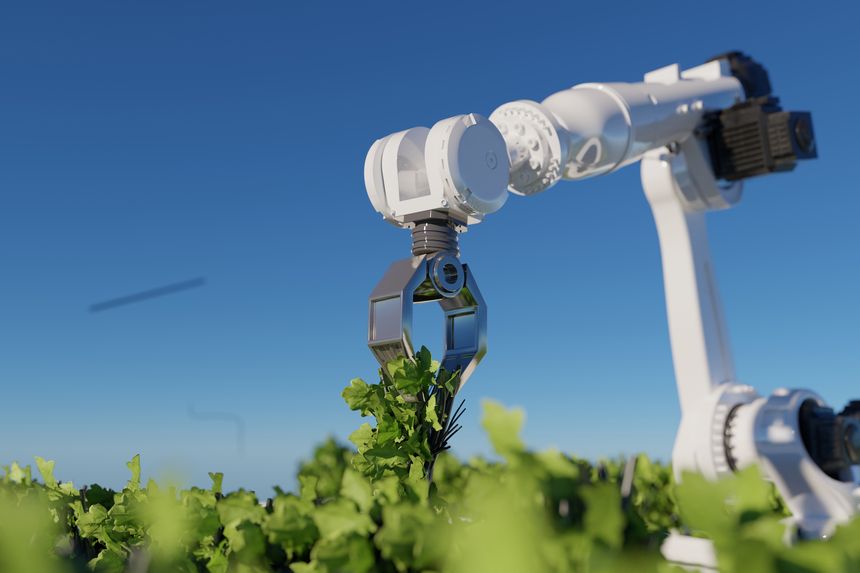
If you visited the MACH 2026 show in Birmingham last week, you likely saw a spectacle of industrial might. The halls were filled with towering robotic arms and high-speed automated systems designed to streamline heavy manufacturing and factory workloads. It was impressive.
I left the show wondering: where is this innovation for the domestic market? Where are the robots that can handle the delicate, unpredictable world of horticulture?
My post-show deep dive led me to a breakthrough that feels much closer to home. Researchers at Wageningen University & Research (WUR) are pioneering a new way to bring robots into the greenhouse—and they are doing it by building a world that does not actually exist.
The Problem with "The Real World"
In a car factory, everything is predictable. The parts are rigid, the lighting is constant, and the floor is flat. In a greenhouse, everything is the opposite. A tomato plant is soft and fragile; it grows in a different direction every day, and its leaves cast ever-changing shadows.
Teaching a robot to navigate this complexity used to take years of trial and error in physical greenhouses. If you wanted to test how a robot picked a pepper in different lighting, you had to wait for the sun to move.
Enter the Digital Greenhouse
WUR has solved this bottleneck by developing a high-fidelity simulated greenhouse environment. The research integrates expertise from across WUR with specialists in robotics, simulation, crop physiology and 3D modelling – the outcome: a hyper-realistic digital twin of a growing environment.
By using “realistic plant models” trained on data encompassing multiple variations within measured boundaries, such as plant height, leaf orientation and fruit position, researchers can train robotic AI on thousands of variations of a single plant. They can simulate different growth stages, pest infestations, and varying light conditions that would take seasons to experience in real life. This "Sim-to-Real" pipeline means that by the time a robot actually enters a physical greenhouse, it has already "practiced" for thousands of hours in a virtual one.
Why This Matters to Us
For those of us passionate about the future of food and domestic gardening, this is a game-changer. This technology lowers the barrier to entry for agricultural robotics, making it faster and cheaper to develop tools that can:
Identify and harvest ripe fruit without bruising.
Spot early signs of disease on individual leaves.
Manage vertical gardens and domestic greenhouses with precision.
It’s a beautiful blend of Dutch agricultural heritage and cutting-edge tech. We are moving away from the "one size fits all" industrial robot and toward intelligent, "green-fingered" machines that understand the nuances of nature.
Dive Deeper
To see the technical wizardry behind how they are bridging the gap between simulation and reality, check out Vision+Robotics and the article 'WUR develops simulated greenhouse environment for faster robot development'.
The future of the greenhouse is looking greener—and smarter—than ever.

/Passle/6130aaa9400fb30e400b709a/SearchServiceImages/2026-10-12-13-30-55-175-6acce10f6b66afb021ebc8ea.jpg)
/Passle/6130aaa9400fb30e400b709a/MediaLibrary/Images/2026-10-08-10-26-42-897-6ac76fe27241551f573ec3f7.png)
/Passle/6130aaa9400fb30e400b709a/SearchServiceImages/2026-10-12-00-52-51-983-6acc2f634c75093d7cd4768f.jpg)