
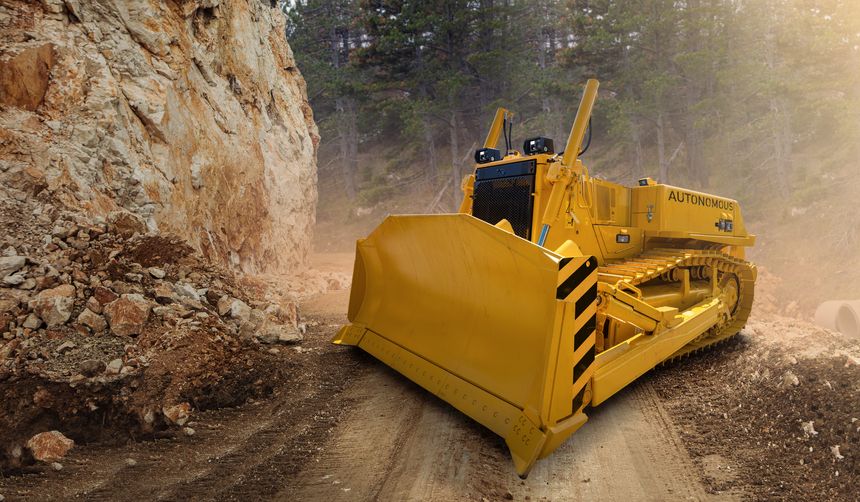
The mining industry’s move toward autonomous and semi‑autonomous operations is already underway, but it is now entering a new phase and the industry is taking notice. As described in a recent article, The Rise of the Autonomous Mine, that appeared in the Canadian Mining Journal, artificial intelligence (AI), real‑time data systems, and increasingly autonomous equipment are reshaping how decisions are made—from early exploration through to production. What used to take weeks now happens in hours, sometimes minutes. That is operational progress. It is also an Intellectual Property (IP) event.
From a technology law perspective, what is most interesting is not that autonomous systems exist, but where the value is actually being created — and captured. Innovation in complex environments like this rarely arrives as a single, patent‑ready breakthrough. Instead, it appears incrementally: a tweak to how sensors are calibrated underground, a revised rule set for real‑time ore sorting, or a site‑specific way of integrating AI outputs into equipment controls. Those individual changes are often developed quietly by engineers and operations teams, and they frequently never register as IP at all. Inventive people often have the somewhat self-defeating perception that their contributions were minor or obvious improvements to the state of the art, when many such improvements may, in fact, meet the standard for patent protection—or should at least be reviewed by management.
Despite common assumptions, patents still matter here. While raw data and abstract algorithms may not be patentable in some jurisdictions, many autonomous mining innovations remain firmly grounded in physical systems—machines, sensors, control logic, and industrial processes. This connection to the physical world can be a grounding factor that can provide a basis for patent protection, and is an advantage that mining innovators have over pure software and web-based innovations. For example, a method that changes how drilling decisions are executed based on AI‑derived targets, or a control architecture that allows equipment to shift safely between autonomous and human‑supervised modes, may well be patentable. One challenge is timing. By the time a pilot project is public, a trial is underway, or a vendor demo is complete, patent options may already be constrained — because most national patent laws require that a patent application is filed before the described technology is publicly disclosed.
Data, as the article correctly notes, is both the enabler and the bottleneck. Legally, it is also where risk tends to hide. Autonomous mining environments may generate vast quantities of operational data, often processed by third‑party platforms or shared with partners during testing and validation. Without careful agreements, ownership of raw data, cleaned/curated datasets, and AI‑derived outputs can become blurred. This is particularly sensitive where operational data is used to train models that may later be deployed elsewhere.
Well‑structured datasets and the workflows used to create them may qualify as trade secrets in some jurisdictions, but under some regimes this will only apply if companies take active steps to protect them. Also, trade secret legislation differs between countries (and provinces) and is generally less harmonized than patent laws globally, which can lead to inconsistent treatment of such information. In practice, developing a trade secret means more than stamping documents “confidential.” Sensible trade secret protection in this context often includes having a proper trade secret policy — and then actually implementing what the policy requires (a step that is sometimes overlooked). This can mean limiting access to curated datasets to defined internal roles, separating raw data from value‑added datasets, and ensuring that employees, contractors, and vendors are all subject to clear confidentiality and use‑restriction obligations, for example. It also means documenting, even briefly, why certain data assets are commercially sensitive—an unglamorous step that becomes very useful if protection is ever challenged.
On the technical side, data protection is not just a legal exercise. One increasingly common technique is controlled data partitioning, where sensitive operational datasets used to train AI models are segmented so that vendors or collaborators only receive the minimum data necessary for a defined task. This approach does not replace contracts, but it reinforces them—and courts tend to look favourably on companies that align technical controls with legal protections (i.e. actually doing what their policy says).
Testing environments and underground validation centres add another layer of mining-specific complexity. These facilities may be needed for innovation, but they are also environments where ideas evolve quickly in the presence of multiple parties. Improvements made during testing, even small ones, can become valuable IP. If ownership of those improvements is not addressed in advance (by a collaboration or joint development agreement, for example), disagreements tend to arise only after something works particularly well and there are real dollars at stake.
The broader takeaway is that autonomous mining is not merely a technology transition. It is a redistribution of value toward decision logic, data handling, and system integration. That is exactly where traditional IP identification processes tend to lag behind operations. The companies that do best in this environment will be those that recognize that innovation is already happening on site and treat IP strategy, data governance, and contractual discipline as part of their autonomous mining roadmap—not as a cleanup exercise once the trucks are already driving themselves.
Autonomous mines may still be in development. Their intellectual property, however, is already being created—whether it is being protected or not.
The future of mining is not just automated, it is informed. Salima Virani, The rise of the autonomous mine, April 30, 2026

/Passle/6130aaa9400fb30e400b709a/SearchServiceImages/2026-10-16-13-28-09-937-6ad22669de6b66bfe10f1be3.jpg)
/Passle/6130aaa9400fb30e400b709a/SearchServiceImages/2026-10-15-13-59-24-760-6ad0dc3caa6596dee349c576.jpg)
/Passle/6130aaa9400fb30e400b709a/SearchServiceImages/2026-10-15-09-22-55-529-6ad09b6f294f5d4c2d2ceea7.jpg)