
This article was prepared with our summer student Xianda Gao.
Critical minerals are becoming increasingly important to global supply chains, due to their key role in modern technologies. However, finding a secure, reliable supply of these important minerals remains a challenge. One emerging approach is to recover these minerals from mining waste — materials such as tailings and waste rock that remain after conventional extraction processes, which have traditionally been viewed as byproducts, but which can still contain valuable metals.
To facilitate this approach, the Government of Ontario has established the Ontario Critical Minerals Strategy which provides sufficient flexibility to allow mine waste to be reprocessed without needing additional permissions such as a mining lease for public land or a full closure plan. Companies and research institutions are also looking for ways to develop new technologies to help commercialize the waste extraction process and are seeking patent protection for these innovations.
A key technology increasingly being used to recover critical minerals from mining waste is hydrometallurgical processing, which uses liquid-based processes to extract metals from solid materials. When applied to mining waste, these processes provide a pathway to recover critical minerals while making use of existing resources. Because patents are often filed when new technologies are being developed for possible commercial use, patent filing trends can provide a useful measurement of both research activity and expected commercial interest.
To better understand how activity in this area is evolving, we looked at global patent filing data from the European Patent Office’s database during 2015 to 2025 to surface trends in the area of hydrometallurgy and hydrometallurgical processes. The data included both patent applications and granted patents that were identified through a combination of classification codes and keywords related to mining waste and metal recovery. Filtering was used to exclude unrelated sectors and to examine activity linked to specific minerals.
Growth in mining waste recovery and critical minerals technologies
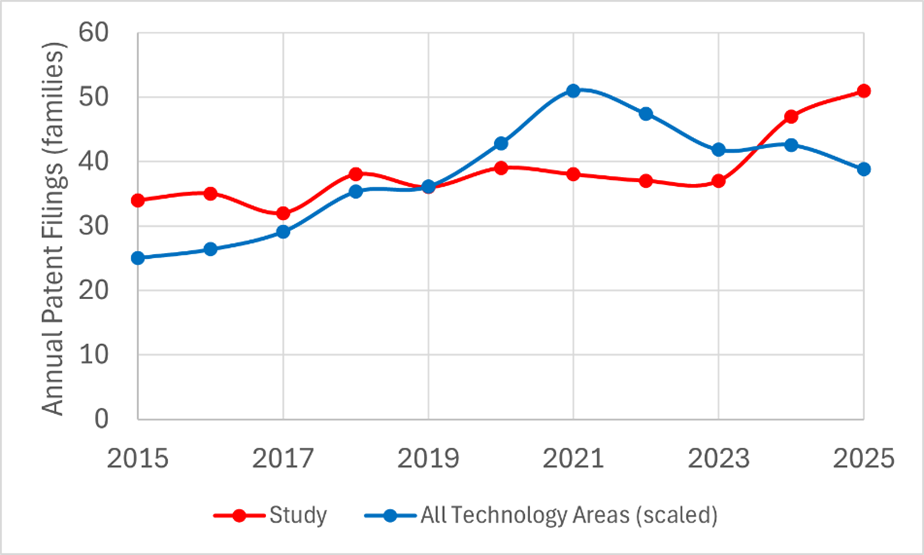
The data shows that patent filings for hydrometallurgical processing of mining waste for recovery of critical minerals remained relatively steady between 2015 and 2023. Most notably, filings increased sharply in 2024 and 2025, with an annual increase of about 18%. Importantly, this trend runs counter to broader global patterns; across all technology sectors, patent filings peaked in 2021 and subsequently experienced slight annual decreases of 2.5% in 2024 and 2025.
A similar contrast appears when comparing this field with hydrometallurgy more broadly. Patent filings for hydrometallurgical processes in general have been increasing steadily since 2020. However, the sharper rise observed in 2024 and 2025 for mining waste processing highlights a more focused shift toward recovering minerals from previously discarded materials. These trends point to growing interest in developing technologies that recover critical minerals from waste materials.
Geographic concentration of patents related to hydrometallurgy
Patent activity in this field is concentrated in a small group of countries. China, Australia, the United States, and Canada together accounted for more than 95% of filings over the period studied.
Patent filings for processes relating to lithium, copper, nickel, cobalt, and rare earth metals all reached recent highs in either 2024 or 2025. In particular, filings directed to lithium recovery from mining waste increased sharply over 2023 to 2025, rising by over 200% annually. This suggests that the recent growth in patent activity is being driven in large part by efforts to recover lithium, rather than by uniform growth across all critical minerals.
In addition to the Ontario Government’s Critical Minerals Strategy, mentioned above, there has been increased practical activity in this field. Projects focused on recovering metals from tailings are beginning to emerge, including Ontario’s first permit under its Recovery of Minerals regime in early 2026 for a historical tailings reprocessing project in Timmins, Ontario. Together with the recent rise in patent filings, it is expected that commercial activity involving hydrometallurgical processing of mining waste will see increase in the coming years to meet the rising demand for critical minerals.
A more detailed analysis of this topic will be presented at the Conference of Metallurgy and Materials (COM) 2026 from August 17–20; further details about the conference are available at https://com.metsoc.org/. If you have any questions about patents, you can reach out to our patents team.

/Passle/6130aaa9400fb30e400b709a/SearchServiceImages/2026-10-15-09-22-55-529-6ad09b6f294f5d4c2d2ceea7.jpg)
/Passle/6130aaa9400fb30e400b709a/SearchServiceImages/2026-10-14-14-46-12-016-6acf95b46432c6c1a4f4c47a.jpg)
/Passle/6130aaa9400fb30e400b709a/SearchServiceImages/2026-10-14-12-43-15-442-6acf78e391778041f0062bf0.jpg)