
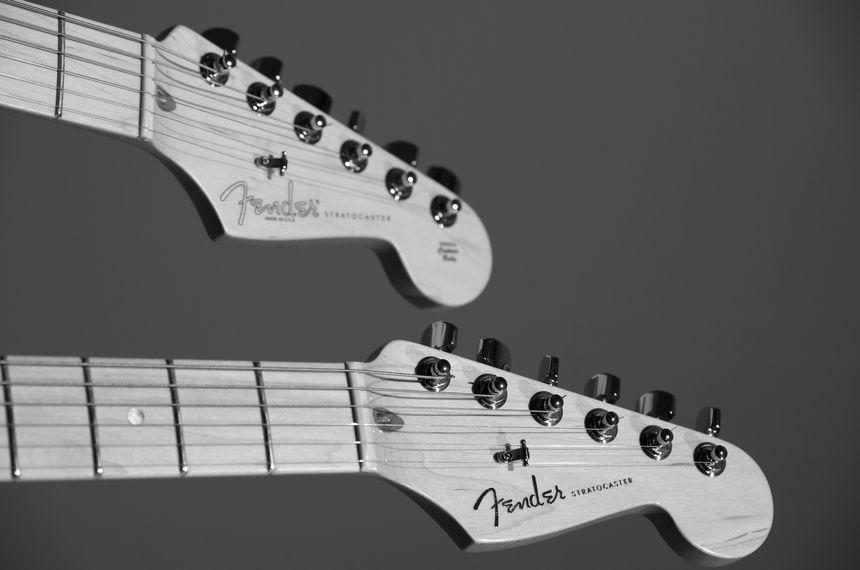
Recent reports suggest that American guitar maker Fender has stepped up its legal action to assert intellectual property (IP) rights in its iconic Stratocaster guitar, including sending cease-and-desist letters to rival guitar manufacturers.
As a guitarist and a patent attorney, I was surprised and intrigued by these reports. Fender launched the Stratocaster (or “Strat” for short) in 1954, and it has been widely copied ever since. How can Fender assert its IP rights in the Stratocaster after all this time, and could they take similar action in the United Kingdom?
What makes a Stratocaster?
The Stratocaster is one of many guitars designed by Leo Fender, the founder of the Fender Electric Instrument Company (now known as the Fender Musical Instruments Corporation). Leo Fender was a prolific inventor who, alongside designing the Jaguar, Jazzmaster and Mustang six-string guitars, designed the seminal Precision Bass and Jazz Bass four-strings and many enduring guitar and bass amplifiers. He was named as the inventor on numerous patents covering guitar pickups, bridges and machine heads, amongst other things.
The Stratocaster wasn’t Leo Fender’s first electric guitar but, with respect to devotees of the also hugely popular Telecaster, was arguably his most iconic guitar. Many music legends have played Strats as their go-to guitars over the years, including Buddy Holly, Hank Marvin, Eric Clapton, Jeff Beck, Jimi Hendrix, David Gilmour, Mark Knopfler and Stevie Ray Vaughan.
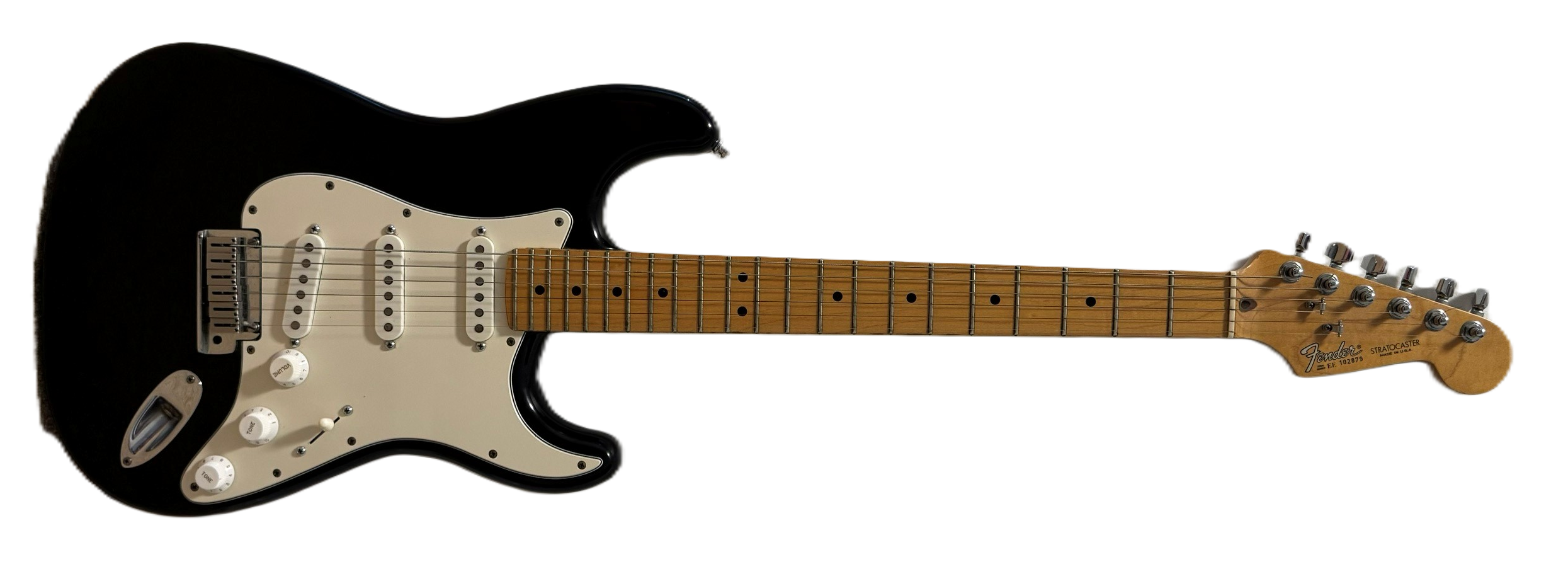
With hindsight, Leo Fender’s recipe for a Stratocaster seems simple: a rounded solid body, with rear contours for comfort and two deep cutaways for easy access to the higher frets; a large scratchplate, which is home to three single-coil pickups; a tremolo bridge; a neck with simple dots as position markers; and a headstock with a rounded tip, flared midsection and a row of six machine heads. This combination of ingredients produced a guitar that is a joy to play, has great tonal versatility and whose appearance embodies rock ’n’ roll.
(Image: author's own)
Many guitar makers copied Leo Fender’s recipe in the years that followed, producing visually similar guitars of differing quality to suit every wallet. But only guitars made by Fender could carry the Fender name, with all its cachet and heritage.
Fender’s legal action
The background to the latest action appears to be proceedings brought by Fender before the Regional Court of Düsseldorf against Yiwu Philharmonic Musical Instruments Co. (“Yiwu”), a Chinese company selling Strat-style guitars into Germany via AliExpress. The court found in favour of Fender in March 2026, reportedly deciding that the design of a Stratocaster’s body qualifies as a copyrighted work of applied art under German and European Union law.
A couple of procedural points are worthy of comment. First, this was a default judgment according to some reports, meaning that Yiwu did not appear before the court or put up a determined defence to Fender’s legal arguments. Furthermore, this was a first instance judgment, meaning that the Regional Court’s judgment has not been reviewed by a higher court.
Nevertheless, the Regional Court’s judgement seems to have emboldened Fender into taking action against other manufacturers of Strat-style guitars. Whilst most manufacturers have not publicly admitted to receiving cease-and-desist letters, American manufacturer LsL Instruments have launched a crowdfunding campaign to raise money to defend themselves.
Imitation is the sincerest form of flattery
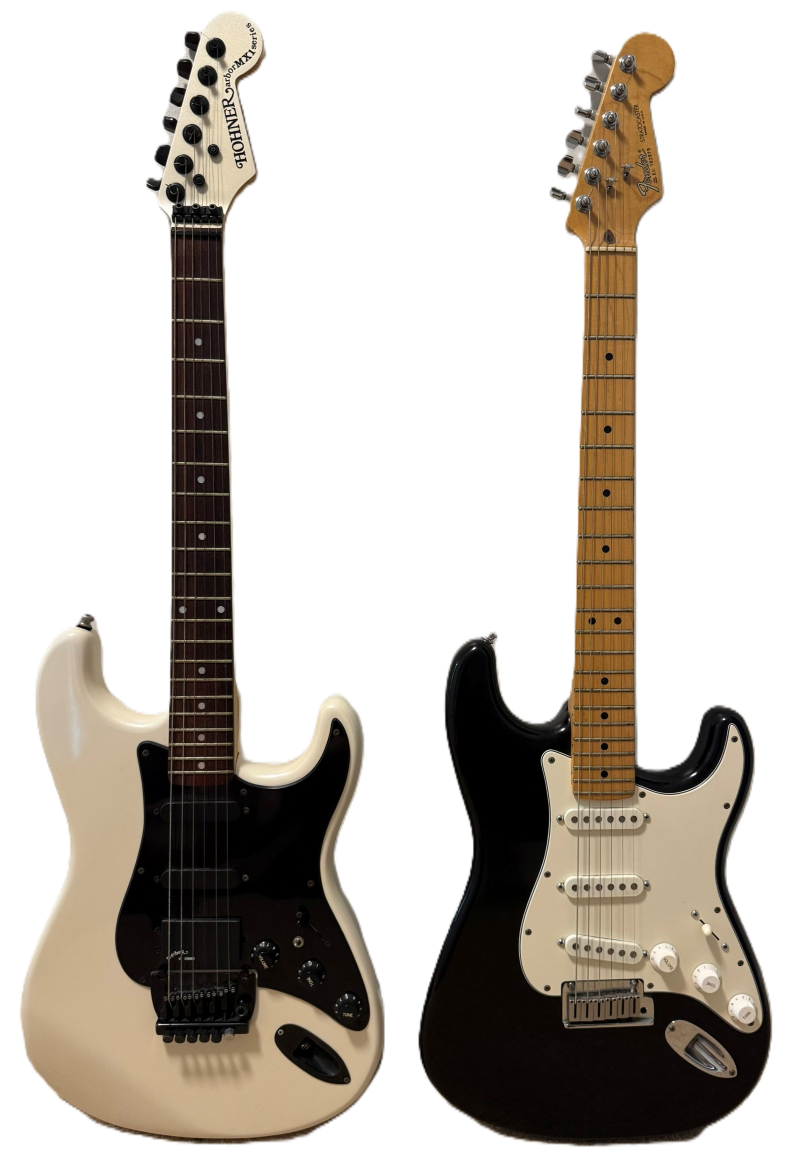
Yiwu are not the first company to copy the Stratocaster style, and I doubt they are even the most prolific. For example, the photo on the left below shows my own Strat-copy. Made in the Republic of Korea by German company, Hohner, this was one of many Strat-influenced guitars for sale in the late 1980s. I learned the basics with this copycat guitar, but always aspired to own the real thing until eventually I bought the Fender American Standard Stratocaster shown on the right.
(Image: author's own)
Setting aside the obvious differences in colour, and the more subtle differences in their pickups and tremolo systems, the appearance of the two guitars is essentially identical. The Fender is undoubtedly a better-sounding, higher-quality instrument but, in terms only of their appearance, there is little to choose between the two.
Other guitarists will undoubtedly have their own stories of progressing from cheap Strat copies to the real thing. Those guitarists will surely wonder how Fender can hope to monopolise a style of guitar that has been widely sold by other companies for decades. The answer lies in Fender’s intellectual property rights.
Fender’s IP in the United Kingdom
When most guitarists think of IP, their mind turns first to copyright. Copyright is, after all, the IP right that protects their own musical works. Moreover, copyright was also the right asserted successfully against Yiwu in Germany. However, UK copyright law is significantly less helpful for Fender.
The Stratocaster was designed at a time when UK law was very different from today. The Copyright Act 1911 was still in force, and made clear that copyright did not apply to industrial designs. At that time, there was no counterpart to present-day unregistered design right, which provides short-term protection to industrial designs. UK law did not - and still does not - have any equivalent to the German law conferring copyright upon works of applied art.
Fender had no UK patents covering the Stratocaster and, even if they did, those patents would have long since expired. Similarly, any registered designs that might once have existed would have expired decades ago.
Fender do, however, own a substantial portfolio of trade marks covering the Stratocaster. The words “STRATOCASTER” and “STRAT” have been registered as trade marks in the UK since the 1970s, meaning that other manufacturers cannot use those words to describe their own Strat-style guitars.
More interestingly, Fender have registered several UK three-dimensional trade marks in respect of the Stratocaster headstock. These are:
UK00002050647 (filed in 1996) protecting the Stratocaster headstock shape with the Fender logo appearing in its time-honoured position.
UK00903318474 (filed in 2003) protecting the profile of the Stratocaster headstock. Unlike the previous mark, this mark does not require the Fender logo to be present.
UK00905601232 (filed in 2006) protecting the profile of the wide headstock found on Stratocasters in the 1960s and 1970s. This mark also does not require the Fender logo to be present.
On the face of it, the second of these three-dimensional marks prevents other companies using the famous Stratocaster headstock shape, or even a similar shape, for their own guitars.
One might ask, how could these trade marks have been registered? The function of a trade mark is to act as a badge of origin, which distinguishes the goods and services of one business from those of other businesses. Can the profile of the Stratocaster headstock still serve this function when guitars with the same headstock shape had been widely sold by other manufacturers long before Fender filed their own trade mark applications? Those are questions that the courts or United Kingdom Intellectual Property Office might have to answer if Fender were to assert their UK trade marks against other manufacturers.
A lesson in protecting IP
Fender's trade mark portfolio shows that they took IP seriously long before their recent action against Yiwu. Fender clearly recognised the huge commercial value in the Stratocaster, and proactively built a moat around it by registering both the name and headstock shape as trade marks. Unlike many other IP rights, these trade marks could last indefinitely and thus forever lock in the value created by Leo Fender to the business that bears his name.
Whatever your view on the rights and wrongs of Fender's recent actions, one must surely applaud their efforts to build value in their business.

/Passle/6130aaa9400fb30e400b709a/SearchServiceImages/2026-10-15-09-22-55-529-6ad09b6f294f5d4c2d2ceea7.jpg)
/Passle/6130aaa9400fb30e400b709a/SearchServiceImages/2026-10-14-14-46-12-016-6acf95b46432c6c1a4f4c47a.jpg)
/Passle/6130aaa9400fb30e400b709a/SearchServiceImages/2026-10-14-12-43-15-442-6acf78e391778041f0062bf0.jpg)