
This week, the Canadian IP community will gather in Ottawa for the Annual Conference of the Intellectual Property Institute of Canada (IPIC), and excitingly to celebrate IPIC100, its centennial anniversary. Marks & Clerk are proud to sponsor IPIC100 and the Welcome Reception that will open the conference on Wednesday night.
We spoke with our Canadian partner Jean-Charles (JC) Grégoire, who is currently the Chair of the Industrial Design Committee of IPIC. His appointment to that leadership role was announced at the last IPIC Annual Meeting, and JC will hold this post for a term of two years.
As JC progresses through his term, he shared more about the work of the committee, what he enjoys about leading the committee, and his outlook on trends and potential developments in design law and practice in Canada.
What is the role and purpose of the IPIC Industrial Design Committee and what do you enjoy about your role as the Chair?
The primary role of the Industrial Design Committee is to review and make recommendations to amend policy that may affect the industrial design system in Canada, identify facets of industrial design policy in need of reform, and keep all members informed of developments within the areas of industrial designs. We engage primarily with the Canadian Intellectual Property Office (CIPO) to advocate for the interests of the Canadian IP Profession.
While I have been an active member of the committee for over ten years, it is a pleasure to serve as Chair, lead discussions and projects, invite and respond to members’ feedback, and report and provide support to the IPIC Board.
How often does the Industrial Design Committee meet and what are the current priorities?
The committee holds in-person meetings during the IPIC Annual Meeting, the committee corresponds periodically by email and meets throughout the year virtually.
In addition, around three times a year, members of the IPIC Industrial Design Committee and representatives of the Industrial Design Office at CIPO hold Industrial Design Practice Committee meetings, to broaden and strengthen communications between CIPO and the industrial design stakeholders, and to identify and discuss issues with a view to improving industrial design practice and services to clients. Members of the IPIC Industrial Design Committee also work together on an ad hoc basis to respond to consultations by CIPO or assist IPIC with projects. For instance, right now we are updating the IPIC Fundamentals of Industrial Design Course, an online training program.
At our first meeting this term, we asked CIPO for an update on the implementation and timing of the international Design Law Treaty.
What can you tell us about Canada’s progress with implementing the Design Law Treaty (DLT) and other international laws related to Designs?
The DLT aims to harmonize procedural requirements for obtaining industrial design protection. A Canadian delegation, including CIPO, attended a Diplomatic Conference in November 2024, which concluded with the successful adoption of the DLT after almost 20 years of negotiation.
A number of countries have not yet signed the DLT, including Canada, and thus far it has been ratified, or acceded to, by only four countries, namely Albania, El Salvador, Georgia and Saudi Arabia. The DLT will enter into force three months after there have been 15 ratifications or accessions. According to CIPO, Canada is considering accession and potential implementation in the future, and much work remains ahead in this regard.
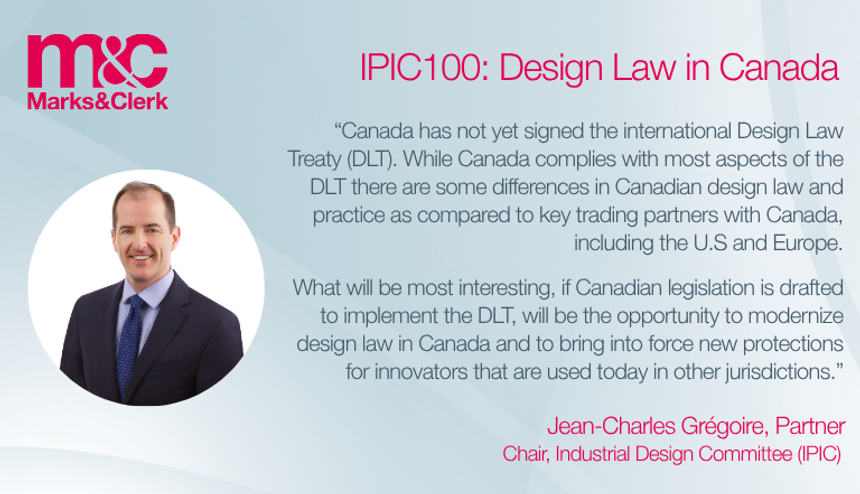
What will be most interesting, if Canadian legislation is drafted to implement the DLT, will be the opportunity to modernize design law in Canada and to bring into force new protections for innovators that are used today in other jurisdictions.
What improvements would you like to see introduced to modernize and enhance design protection in Canada?
Canada already complies with most aspects of the DLT. However, there are some differences in design law and practice as compared to key jurisdictions which are key trading partners with Canada.
In my discussions with IP practitioners in the U.S and Europe who focus on designs, and as a member of the AIPLA Design Rights Committee, there are some interesting developments that Canada would benefit from implementing into our design laws.
Some of these include:
Notice of Allowance for designs. In Canada, unlike the practice for patents, CIPO does not issue a Notice of Allowance to applicants before an approved design is registered. A workaround involving requesting delay of registration can be used, but it involves additional steps and costs. Providing advance notification of registration would afford applicants an opportunity to consider divisional applications prior to registration.
Appendices. The USPTO generally permits applicants to include appendices in design patent applications. The appendices contain additional views, alternative embodiments, or supplemental drawings, which are intended to serve as a basis for future design amendments or continuation applications, while still benefiting from the original filing date. CIPO does not have examination guidelines addressing appendices in industrial design applications. Developing and publishing such guidelines could help applicants understand how they may be used as a basis for drawing amendments or divisional applications.
3D printing design protection. In 2025, the EU introduced protection against unauthorised creation, sharing, downloading and distribution of design files, namely digital files containing instructions for additive manufacturing or 3D printing an article incorporating a registered design. Similarly, extending the scope of protection in Canada would ensure that holders of design rights have adequate protection amid the continued expansion of additive manufacturing technologies across industries.
It is important to note that these and other ideas are all in the early stages of discussion by the IPIC Design Committee.
What is your outlook on the landscape for Designs protection in Canada?
Practice and system changes are expected to improve service delivery by CIPO, following a Red Tape Review that was conducted in consultation with the committee. CIPO is also expected to continue enhancing e-services in response to growing interest in registering designs in Canada.
IPIC is celebrating its 100th anniversary in 2026, marking a century of innovation, protection of ideas, and shaping the IP landscape. I look forward to joining its centennial conference this week and reconnecting with the many colleagues whose contributions and support have helped strengthen the IP community.
Subscribe to receive more articles like this here.

/Passle/6130aaa9400fb30e400b709a/SearchServiceImages/2026-10-23-08-18-54-691-6adb186ebd29a7ce1f63fc00.jpg)
/Passle/6130aaa9400fb30e400b709a/MediaLibrary/Images/2026-10-21-11-59-19-999-6ad8a9179207ce3b4702378c.png)
/Passle/6130aaa9400fb30e400b709a/SearchServiceImages/2026-10-16-11-15-18-770-6ad20746ee7a454c2dbe1b59.jpg)