
In March, the Board of Appeal issued a judgement (T 0847/24) showcasing an unusual interaction between seemingly distant provisions of the European Patent Convention (EPC). The Board held that, in a method of designing a product, adding a further step of manufacturing the product represents an extension of scope, and is therefore impermissible when tried post-grant.
Facts of the Case
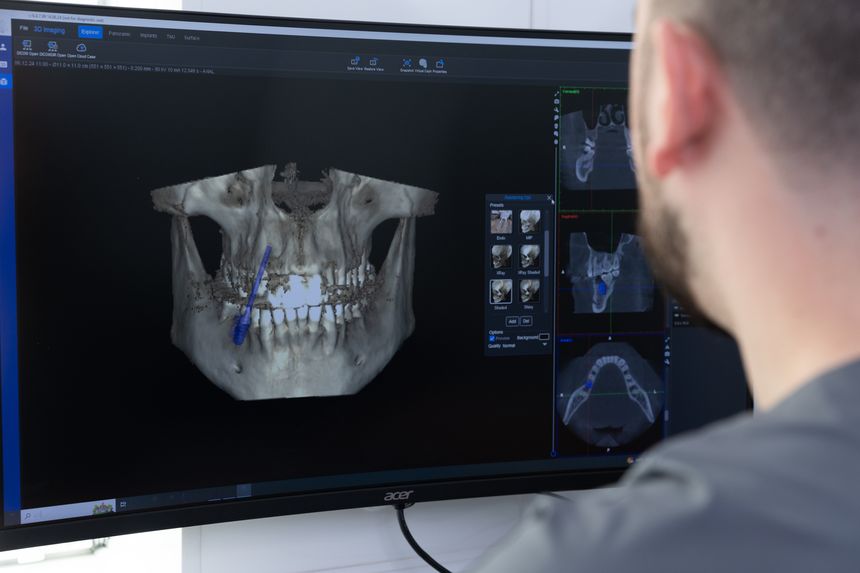
The invention at hand relates to a computer aided design method of an implant for maxillofacial osteosynthesis (a surgical procedure used to stabilise damaged facial or jaw bones) customised to a specific patient. The method uses a 3D model of a patient’s bone structure, then simulates an osteotomy on the model. The resulting changes to the bone structure are predicted to generate a modified 3D model as an illustration of the intended restored facial anatomy of the patient. The modified model is then used to determine an appropriate 3D structure for a supporting implant customised to the patient.
As claimed upon grant, the method was for “configuring a surgical guide and an associated implant”, or, in other words, for designing an implant. The claims did not originally include any step of building or manufacturing a component, though this was disclosed in the description. The patent was opposed on the basis that this method lacked a technical effect as it related only to simulation. Following the landmark Enlarged Board decision of G1/19, the position of the European Patent Office (EPO) is generally that simulation methods lack a technical effect if they lack a direct link with physical reality.
The appellant and patent proprietor sought to argue in favour of patentability in an auxiliary request by amending the method to be for configuring “and producing” the guide and associated implant. This was argued to confer a technical effect, and therefore overcome the inventiveness objections.
Contrary to Article 123(3) EPC, this amendment was deemed by the Board of Appeal to extend the scope of protection of the patent. Surprisingly, the Board reached this conclusion despite acknowledging that the method itself is being limited by the amendment!
Rather, the extension of protection arose due to Article 64(2) EPC, which states:
“If the subject-matter of the European patent is a process, the protection conferred by the patent shall extend to the products directly obtained by such process.”
The key term here is “directly”. In claim 1 as granted, it was held that what is directly obtained by performing the method is just data, or perhaps a physical medium storing the design.
In the Board’s (and opponent’s) view, going further to produce the implant entails further method steps that were neither stated in nor necessarily implied by the granted claims. This meant that producing the implant could only be an indirect result of performing the original method lacking a production step:
“… using the data obtained by carrying out the method defined in claim 1 as granted when manufacturing a physical implant is an entirely different matter. A physical implant is, in terms of its characteristics, far removed from mere data configuring that implant, which is what is obtained when carrying out the claimed method. Therefore, a physical implant is not ‘directly obtained, within the meaning of Article 64(2) EPC, by the method defined in claim 1 as granted.’”
The issue of whether a product is obtained “directly” by a process tends to appear more often in infringement proceedings under the jurisdiction of national courts, not the EPO. In the UK, “directly” has generally been interpreted to mean “without intermediary” and not resulting from further material and important steps. The EPO seem to have adopted a consistent approach here.
The upshot is that the scope of claim 1 as amended would, unlike claim 1 as granted, also have covered the physical implant, even though the amendment limits the method itself. As Article 123(3) EPC forbids post-grant scope extension, the amendment was deemed impermissible. As the applicant was unable to introduce the step of manufacturing the product, the patent was eventually revoked for lack of inventive step.
Lessons and Takeaways
This decision reinforces that best practice for drafting applications to computer-aided design in Europe is to include a step of building the designed product. Including such a step in simulation-aided design cases has been important for years now following the landmark Enlarged Board decision of G1/19, which clarified that such methods would be deemed technical if they had some link with physical reality. Adding a manufacturing step is a clear way to establish such a link and to avoid potential excluded-subject matter type objections at the EPO.
Notably, even if the EPO is willing to grant the patent without the step of manufacturing the product, it is worthwhile including this step at least in a dependent claim. If the applicant in T 0847/24 had included this in a dependent claim before grant, then there would have been no conflict with Article 123(3) EPC, as the patent as granted would have explicitly covered this. In any case, it is good practice to include a dependent claim to this effect, as it could also allow for additional licensing opportunities, as well as the potential for asserting infringement based on the product itself.
Given this, there is now clear value in adding a manufacturing step in a dependent claim before grant, to maximise flexibility in the unlikely event of post-grant proceedings.
If you would like to discuss any of the issues in this article, please feel free to get in touch via mjefferies@marks-clerk.com and emcneil@marks-clerk.com.
Subscribe to receive more articles like this here.


/Passle/6130aaa9400fb30e400b709a/SearchServiceImages/2026-10-23-08-18-54-691-6adb186ebd29a7ce1f63fc00.jpg)
/Passle/6130aaa9400fb30e400b709a/MediaLibrary/Images/2026-10-21-11-59-19-999-6ad8a9179207ce3b4702378c.png)
/Passle/6130aaa9400fb30e400b709a/SearchServiceImages/2026-10-16-11-15-18-770-6ad20746ee7a454c2dbe1b59.jpg)