
As a patent attorney from a physics background, I’m always very excited by interdisciplinary inventions and technical fields that offer a chance for me to move outside of physics and engineering and apply my knowledge to totally new contexts. Over the past couple of years, one of the major areas where I’ve been able to do this is agritech. Attending agritech conferences, I’ve been amazed by how many people there spoke my language and were keen to introduce engineering and software inventions and technology to farming contexts.
From what I’ve seen, one of the big reasons for this is that the idea of “smart farming”, based around data collection and automated processing and operation, is being embraced by many farmers in the UK. This is due to several factors, including increased pressure for comprehensive data on supply chains, the difficulty of monitoring expansive farmlands in areas with poor connectivity, and shortages of agricultural workers in a variety of roles. All of these challenges and more are being embraced by high-tech companies that wouldn’t traditionally be thought of in the context of agriculture, in areas as diverse as satellite-based sensors, automated data processing, and most relevant to this article, robotics.
Against this backdrop of high-tech farming and a need for new solutions to growing pressures, I would like to highlight Versatile RobotX, a spinout from the University of Essex that has just announced securing over a million pounds in investment and innovation funding.
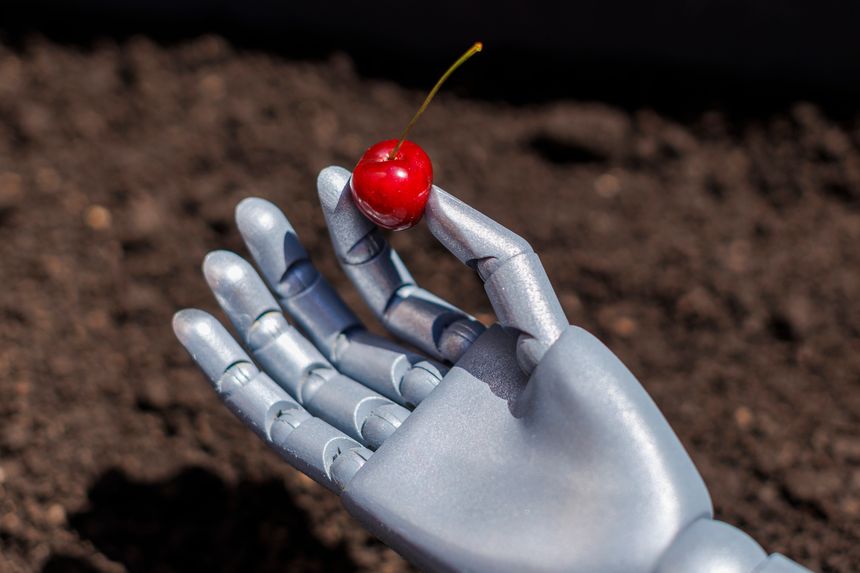
Versatile RobotX is developing robots that automatically harvest crops, with their website currently listing one model for fruit and vegetables and one for hydroponics. Both models are equipped with robotic arms, and, the website states, use machine vision algorithms to autonomously identify ripe crops that are suitable for harvesting. The website describes how these robotic arms are apparently precise and gentle enough to harvest delicate crops without causing damage or reducing quality. Building robotic limbs to be delicate is very difficult and requires a great deal of expertise, both in the design of the limb itself and in the processors that control it.
Beyond the physical aspect of handling delicate fruit with a robotic arm, it’s also interesting to consider the challenges of data processing. Machine vision is generally very computationally intensive, as it’s much more difficult for computers to interpret the world without real, thinking brains like ours. In order to harvest effectively, Versatile RobotX’s robots need to make accurate determinations of crop ripeness, but without taking so long that the harvest is too slow. That’s a formidable technical challenge, and an impressive one to be able to overcome. Data processing will also become more and more important as larger number of robots are used and require coordination.
Still, despite the difficulty of those technical challenges, there’s are strong economic reasons for tackling them. While field-based grain crops like wheat have been efficiently harvested by combine harvesters for over a century, fruit and vegetables can’t be mass-harvested in such a straightforward way without damaging them. That’s why their harvest still typically relies on human labourers to visually assess which crops to pick and manually remove them from the plant individually. This time-consuming and physically demanding process is unfairly considered to be unskilled labour, but requires a great deal of skill and effort on the labourers’ part to perform quickly, accurately and without damage to the harvested crops.
In that context, it’s easy to see why a high-tech solution applying cutting-edge robotics and machine vision is gaining momentum. There’s certainly massive potential to scale across horticulture and related industries if Versatile RobotX can continue their development and overcome the challenging path from spinout to commercially viable operator. It may well be that before too long, entire fleets of similar robots will be moving through greenhouses across the UK to provide the fruit and vegetables we see in supermarkets every day.
Subscribe to receive more articles like this here.

/Passle/6130aaa9400fb30e400b709a/SearchServiceImages/2026-10-26-22-05-27-038-6adfcea7b031da44fe5ecb64.jpg)
/Passle/6130aaa9400fb30e400b709a/SearchServiceImages/2026-10-23-08-18-54-691-6adb186ebd29a7ce1f63fc00.jpg)
/Passle/6130aaa9400fb30e400b709a/MediaLibrary/Images/2026-10-21-11-59-19-999-6ad8a9179207ce3b4702378c.png)