For European patents, efforts to patent methods of presenting information, such as a graphical user interface (GUI), may encounter difficulties in establishing a technical effect that serves a technical purpose. For example, if a feature defining a presentation of information credibly assists the user in performing a technical task by way of a continued and/or guided process of human-machine interaction, this may produce a technical effect, and as such, the feature may contribute to the assessment of the inventive step or obviousness of the invention. On the other hand, subjective preferences, such as use of colour or aesthetic considerations, are likely to be considered to be non-technical and may then be ignored for the assessment of inventive step.
A recent decision T 1149/25 (GUI for therapy selection) on this topic has been issued by the Technical Board of Appeal of the European Patent Office, which relates to the patent EP3665706 held by Amgen Inc. The question of whether a method of generating a graphical user interface for displaying treatment options for a patient contributes to the technical character of the invention was central to the inventive step assessment.
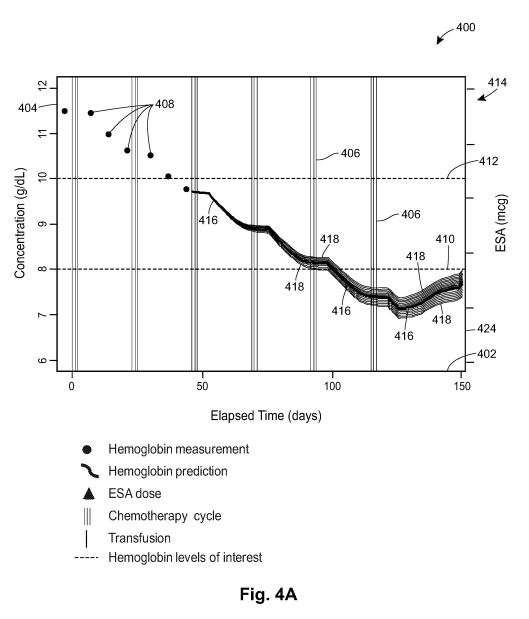
I have not gone into detail about every aspect of the case here, but have chosen to focus on the parts relevant to the question of the technical contribution of the GUI. Claim 1 of the main request was directed to a method of generating a graphical user interface, which involved the use of patient information by a processor, generating proposed treatment schedules and predicted trends, and providing a visual representation for the patient. An example GUI is shown at Fig. 4A reproduced below.
When comparing the closest prior art document (“D2” in the decision), the board considered that the underlined feature of part of Claim 1 was not disclosed in D2:
Displaying, on the graphical user interface, a graph indicating a visual representation of the patient information for the patient, the one or more proposed treatment schedules, and the predicted trends for the hemoglobin levels respectively associated with the proposed treatment schedules.
In other words, the only difference between Claim 1 and D2 was the display of results of its simulation on the GUI. For inventive step before the EPO, the board considered if this feature contributed to the technical character of the invention. Perhaps unsurprisingly, the feature was considered to be a mere implementation of presentation of information.
Amgen had argued that the display on the GUI provided for an efficient division of labour between the computer and the user and a highly efficient allocation of resources, because the computer would do the calculations required for optimising a treatment schedule, but the decision on which treatment schedule to apply was presented to the user and as such it was the clinician who remained in control of decision making.
What I found interesting about the board’s response was that it considered it irrelevant whether the “de-automation” of certain steps of a fully automated prior-art method could contribute to inventive step. In other words, de-automating the decision-making step could be inventive, but this was not the question to ask. It was instead correct to focus on whether the GUI-based presentation of information might contribute to the technical character of the invention. In the board’s view, there should have been a focus on how the distinguishing technical feature over D2 of displaying the relevant information on the GUI credibly assists the user in performing a technical task by way of a continued and guided human-machine interaction process. Effectively, perhaps the proprietor focused too much on the question of obviousness, and not enough on establishing that the display on the GUI had a technical effect, to ensure that the feature could be considered for the inventive step assessment.
The board summarised that they considered there to be no such technical task in this case, and offered a particularly interesting rationale of the difference between the skills required of a medical professional and the question of whether or not a GUI might be technical in the context of inventive step.
The board explained that “choosing an adequate therapy as a function of an extrapolated physiological state prevailing inside a body of a patient is a task requiring technical skills." The board continued: “However, the mere fact that such a task requires technical skills and technical considerations does not render an intrinsically non-technical mental act like designing technical systems (such as the claimed "graphical user interface") technical. In the case at hand, while choosing the correct therapy for a patient on the basis of measured physiological states arguably requires technical skills in the field of medicine, it still remains a non-technical mental act”.
I thought this was an interesting point that even though a GUI may be run on a computer and may display what may be complex proposed treatment options, trends, and other patient information to assist a clinician in making a decision, the creation of a GUI to assist with this process was considered to be a non-technical mental act, and the use of the GUI to choose therapy is also a non-technical use, and as such the distinguishing feature over document D2 could not help to establish inventive step.
Ultimately the proprietor was able to obtain a favourable outcome by adding more features to Claim 1. However, the case highlights an important point that the general features of choosing therapy or presenting a GUI for this to take place are likely to be ignored for inventive step assessment at the EPO unless there is an additional technical feature that assists the user in performing a technical task by means of a continued and/or guided process of human-machine interaction. Of course, the choice on whether to add such a feature to Claim 1 depends on how the invention compares to the prior art, as it could be preferable to add more detail on the prediction or processing steps and to focus on those for inventive step.
Whether you are developing clinical decision support software, personalised medicine platforms or other computer-implemented healthcare technologies, understanding what the EPO considers to be a technical contribution is critical to building a robust patent portfolio. To explore how your innovation can be protected in Europe, please do not hesitate to get in touch with the author of this article, Chris Martin.
Subscribe to receive more articles like this here.