
On 22 September 2026, when speaking at the UN General Assembly, Donald Trump announced that the U.S. government would replace the term "Artificial Intelligence" (AI) with "Super Intelligence" (SI). He argued that the word "artificial" makes the technology sound "fake" and undermines its true capabilities. Under the new order signed on 29 September, U.S. federal agencies are instructed to use "SI" rather than "AI" in official communications, policy documents, and non-statutory documents within the executive branch and to no longer acknowledge the terms “Artificial Intelligence” or “AI”.
Historically, AI and SI were not considered to be the same concept. Academic and technology communities have long used "superintelligence" for intelligence that surpasses human cognitive capabilities, while "artificial intelligence" generally describes today's existing systems and technologies. Trump’s initiative in this context is more of a rebranding exercise, and as with any rebranding on such a large scale, it has ripple effects on the industry and existing players.
Whether the terminology ultimately becomes dominant is uncertain. However, from a brand protection perspective, the announcement has already had very real consequences.
One of the immediate effects of the announcement is a surge in registrations of .si domain names, the country-code top-level domain (ccTLD) for Slovenia. According to figures published by the Slovenian registry, Register.si, the number of registered .si domains increased from approximately 190,700 in August 2026 to more than 420,000 by mid-October 2026.
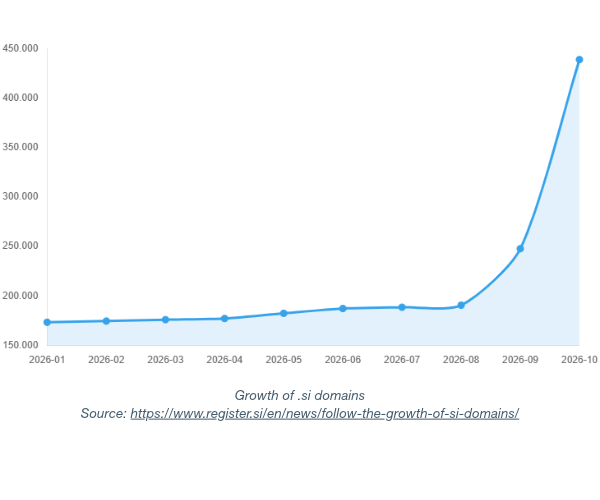
It’s safe to say that this increase in registrations was not triggered by a sudden global interest in the Slovenian economy, but by the announcement itself. While some registrations are undoubtedly made by legitimate businesses trying to preserve their brands’ position in the new context, others are certainly opportunistic registrations by cybersquatters, resellers and malicious actors looking to take advantage of the growing interest in .si.
For the latter, the .si extension is particularly attractive because the registration procedure is extremely simple. Individuals and companies worldwide can register .si domains without maintaining a local presence, local company, or Slovenian trade mark rights. For the same reason, this cannot be ignored by legitimate brand owners.
Additionally, despite the ease of registration, recovering an infringing domain is considerably more complex.
Unlike enforcement applicable to generic top-level domains such as .com, .net or .org, where disputes are resolved under the UDRP framework, ccTLDs, including the .si extension, follow a different path. Domain disputes are handled through an Alternative Dispute Resolution (ADR) procedure administered by the Slovenian registry. Cases are decided by independent arbiters under specific .si rules rather than through the standard UDRP system. For brand owners, there is an additional nuance: a complaint must rely on rights that are valid in Slovenia, such as EU trade marks, Slovenian national registrations and other rights recognised in Slovenia. A foreign registration, such as a US one, may not be sufficient. The procedure is conducted in Slovenian and may require the use of local counsel. In practice, this may require:
- learning a different dispute resolution system;
- dealing with local procedural requirements;
- collecting evidence that meets the requirements of the .si ADR procedure;
- including .si to their brand watch lists.
To put it simply, a domain name that has been registered by a third party within minutes can become a long-term problem for the legitimate brand owner.
While many businesses may decide not to rebrand their company or product name from AI to SI, they should consider whether corresponding SI domains should be acquired as a defensive registration. They should also consider implementing domain name watches covering .si registrations and taking early action against potentially abusive registrations. Defensive actions taken in advance often cost less than recovering a domain after it has been acquired by someone else.
Subscribe to receive more articles like this here.