
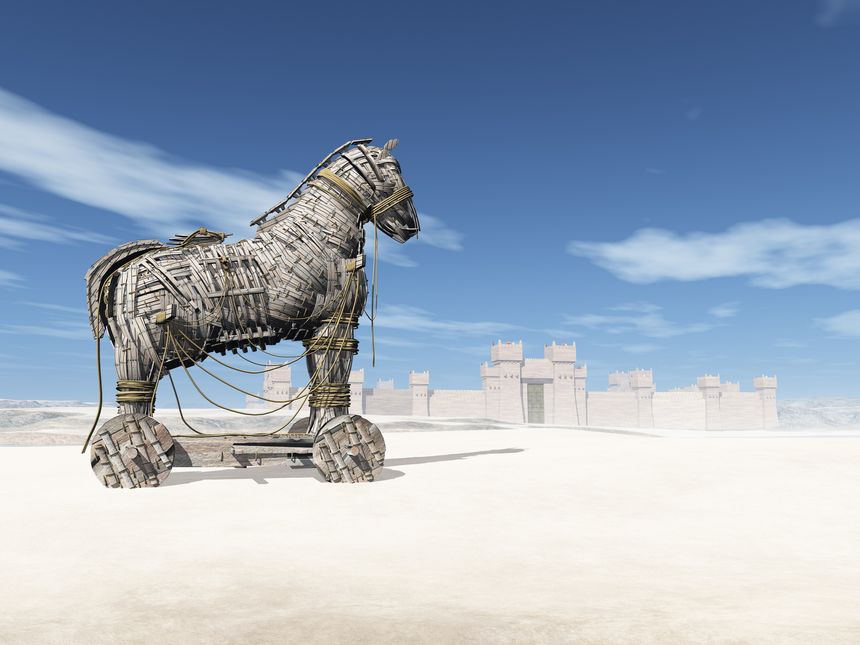
Christopher Nolan's latest film, The Odyssey, was released this weekend. As I watched Odysseus (Matt Damon) emerge from the Trojan Horse and sack Troy (spoilers), an unusual question came to mind: could the Trojan Horse be patented?
Setting aside the minor obstacle that the invention is over 3,000 years old and therefore unlikely to satisfy any novelty requirement, it is interesting to consider whether this infiltration device could have been protected under modern UK or European patent law.
The first question is whether the invention would fall within one of the categories excluded from patentability. Section 1(2) of the Patents Act 1977 and Article 52 EPC exclude certain subject matter from patent protection, including methods of doing business, playing games, performing mental acts and computer programs. However, the Trojan Horse does not sit neatly within any of these categories. Rather than a business method, it is more accurately characterised as a military strategy combined with a physical apparatus. Whilst a claim directed purely to the strategy of deceiving an enemy might struggle to define a sufficiently technical invention, a claim directed to the Horse itself as a physical structure would stand a much better chance of satisfying the requirement for patentable subject matter.
Assuming the Horse was novel and inventive at the time, the next challenge would be publication. A fundamental principle of the patent system is that an inventor receives a monopoly in exchange for disclosing their invention to the public. This presents a difficulty for Odysseus. If Odysseus had consulted his patent attorney, Tiresias, he would have known that any patent application would need to be filed before deploying the Horse, as its use would almost certainly constitute a novelty-destroying public disclosure. Had he filed a patent application eighteen months before deploying the Horse, publication of the application may have rather undermined the element of surprise upon which the entire plan depended.
UK patent law contains a mechanism for dealing with inventions that raise security concerns. Section 22 of the Patents Act 1977 allows the Secretary of State to prohibit or restrict the publication of patent applications where publication would be prejudicial to national security. Whilst the defence of ancient Troy is unlikely to trouble the modern UK Government, the provision highlights an interesting tension between the patent system's goal of disclosure and the desire to keep military technology secret. Had a modern equivalent of the Trojan Horse been developed for military use, it is conceivable that publication of the patent application could have been restricted. This would have been good for Odysseus, in so far as keeping the element of surprise is concerned. He would also have been wise not to have applied for a patent in ancient Crete while any restrictions on publication remained in place lest he fall foul of Section 23 of the UK Patents Act 1977 and could have resulted in summary conviction or a fine not exceeding £1,000.
There is, however, another form of protection which may have suited Odysseus rather well. The distinctive appearance of the Trojan Horse could potentially have been protected by a registered design. Unlike a patent, a registered design protects the visual appearance of a product rather than its technical function. Importantly, UK design law allows publication of a registered design to be deferred for up to twelve months. Odysseus could therefore have secured protection for the Horse's iconic appearance without immediately revealing the details of his siege-breaking strategy to the Trojans.
Whether or not the Trojan Horse would ultimately have survived examination, one conclusion seems clear: even after three millennia, a good invention can still provoke a patent attorney's curiosity.
Subscribe to receive more articles like this here.

/Passle/6130aaa9400fb30e400b709a/MediaLibrary/Images/2026-10-09-10-06-02-856-6ac8bc8a8b2b824748858593.png)
/Passle/6130aaa9400fb30e400b709a/SearchServiceImages/2026-10-08-09-16-14-047-6ac75f5e6e2df5357ce24fc9.jpg)
/Passle/6130aaa9400fb30e400b709a/SearchServiceImages/2026-10-08-08-54-19-301-6ac75a3bd24614eebffad63d.jpg)