
The 2026 FIFA World Cup is well underway, with the world's greatest football teams competing in a tournament being hosted across the United States, Canada, and Mexico. While glass bottles and their metal bottle tops are banned from stadiums for safety reasons, souvenir bottles, bottle tops and bottle openers are widely available, and will no doubt become highly sought-after collectibles (depending, of course, on whether your national team makes it out of the knockout stage).
But as you lever the top off your bottle of carbonated soda or beer with your official England bottle opener, and hear that familiar “pop” followed by a “tshh”, do you ever stop to think about the invention which made sure that your refreshing beverage was still fizzy as you sat down to watch the match, and not flat?
The man you have to thank is engineer William Painter. Born in Triadelphia, Maryland in 1838, Painter set out to tackle the problem of creating a robust seal between bottles containing carbonated drinks and their lids, while still enabling the lids to be removed without the need for specialist tools.
His application for a patent, filed in 1891, sets out Painter's innovative solution: the practical crown-cap bottle closure - a crimped metal cap with a compressed cork liner that provided a reliable, inexpensive, gas-tight seal for bottled beverages while remaining removable with a simple prying tool.
“So far as my knowledge extends”, the patent reads, “I am the first to seal bottles by means of sealing-disks each compressed into close solid contact with the lip of the bottle and maintained in that condition by means of a flanged metallic sealing-cap, the flange of which is bent or crimped into locking contact (while the disk is under pressure) with an appropriate annular locking-shoulder on the head of the bottle, as well as the first to devise methods and means by which in the use of such caps and disks liquids can be bottled under even the highest gaseous pressures employed in this art.”
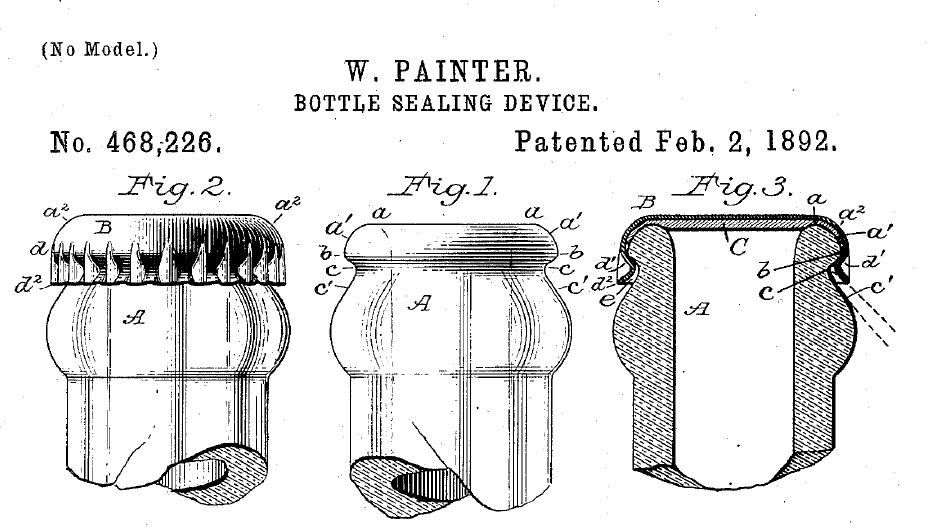
The bottle (A) with which the cap (B) is used has a rounded profile (a), to match the top of the cap. This increases the sealing contact area between cap and bottle, and reduces the risk of the cork sealing disc being damaged by sharp edges on the bottle lip.
Perhaps Painter's key innovation was the creation of a small, annular gap (e) underneath the cap flange (d). This allowed a knife, screwdriver, nail, or indeed any pointed object to be inserted under the cap to pry it off, completely eliminating the need for specialist bottle openers.
Suddenly, a bottle could be bought and opened with pretty much anything, and anywhere - on a lunch break, at the beach, even at a football match. As Painter's patent says, dispensing with the need for specialist opening tools is “always preferable when bottles are required to be opened rapidly”.
William Painter went on to found the Crown Cork & Seal Company in Baltimore, now known as Crown Holdings, Inc., on of the largest metal packaging company in the world. By the 1930s, Crown was selling half of the world's supply of bottle caps, Painter having also invented a machine that streamlined the bottling process, allowing an operator to quickly place a cap on the bottle and crimp it using a foot-powered press at a rate of up to 24 caps a minute.
William Painter died in 1906, with a massive 85 patents under his belt. More than 120 years later, his metal bottle cap remains familiar to anyone who has opened a bottled drink. Modern crown caps may use different materials and sophisticated high-speed manufacturing techniques, but they still rely on the same deceptively simple idea: a metal cap crimped around the neck of a bottle, pressing a sealing liner firmly against the bottle's lip.
So as we experience the elation and disappointment of the 2026 FIFA World Cup, raise a bottle to William Painter. While football may be the beautiful game, a cold beverage at half-time wouldn't be quite the same without the crown-cork bottle cap - one of history's most iconic and successful bottle-sealing devices.
Subscribe to receive more articles like this here.

/Passle/6130aaa9400fb30e400b709a/MediaLibrary/Images/2026-10-09-10-06-02-856-6ac8bc8a8b2b824748858593.png)
/Passle/6130aaa9400fb30e400b709a/SearchServiceImages/2026-10-08-09-16-14-047-6ac75f5e6e2df5357ce24fc9.jpg)
/Passle/6130aaa9400fb30e400b709a/SearchServiceImages/2026-10-08-08-54-19-301-6ac75a3bd24614eebffad63d.jpg)