

With World IP Day upon us and the theme of IP and Sport, we've looked at the IP behind a key technology innovation in Baseball.
As the Toronto Blue Jays move through the current Major League Baseball (MLB) season, the shadow of last year’s dramatic World Series run still looms large. Toronto pushed the Dodgers to seven games in the 2025 Fall Classic before falling in a heartbreaking Game 7 at Rogers Centre, a reminder of how thin the margins can be at the highest level of the sport. A single pitch, measured in inches or fractions of an inch, can determine the outcome of a season.
Those same razor‑thin margins are now increasingly shaped not just by human judgment, but by MLB’s Automated Ball‑Strike (ABS) system. The ABS system is built on the Hawk‑Eye® camera tracking system that also powers Statcast®, allowing MLB to measure and adjudicate balls and strikes with unprecedented precision. World Intellectual Property Day offers an opportunity to look beyond the on‑field debate and examine the intellectual property and technological foundations that made this shift possible.
From Hawk‑Eye to ABS
Hawk-Eye® is based on the principle of triangulation, combining visual images and timing data from multiple high-speed cameras placed around the area of play.
Hawk‑Eye® is the brainchild of Dr Paul Hawkins, a keen sportsman and county‑level cricketer who also holds a PhD in artificial intelligence. In 1999, Hawkins joined UK technology firm Roke Manor Research, where he applied computer‑vision and signal‑processing techniques to the problem of tracking fast‑moving objects in three‑dimensional space.
Roke Manor Research sought to protect this early work through patent filings, including GB 9929193.2 and a corresponding PCT application, WO 01/41884. Although these applications were directed at a cricket use case (see Figure 1 of the PCT application below), the claims relate more generally to a “video processing system for use in ball games” covering any ball-based sport.
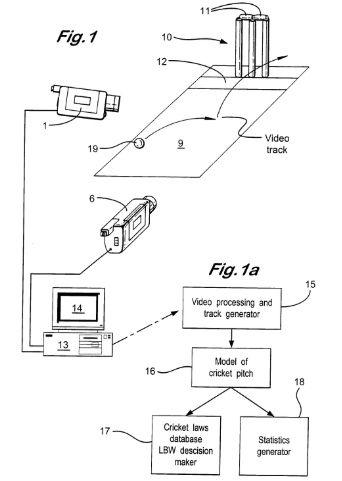
Those early filings ultimately did not proceed to grant. Nevertheless, the technology, research insights, and associated know‑how were later spun out into a dedicated commercial venture, Hawk‑Eye Innovations Ltd. The name “Hawk‑Eye” was chosen deliberately to reflect both Hawkins’ surname and the exceptional eyesight of hawks, signalling the system’s aim of visual perception that exceeds human capability.
Hawk-Eye Innovations launched its camera-based system in 2001 as a broadcast enhancement in sports such as Test cricket, where trajectory visualisations added context for viewers. The system was first used during a Test match between Pakistan and England at Lord’s Cricket Ground, on April 21, 2001.
Hawk‑Eye’s Patent Portfolio and Sony Ownership
Following its commercial launch, Hawk‑Eye Innovations expanded rapidly across sports including tennis, cricket, football, and rugby. Eventually it evolved into an officiating system trusted by professional sports bodies worldwide. For example, 2002 saw Hawk Eye's debut in tennis, and by 2005 it was being used by umpires for officiating purposes.
During this period, Hawk‑Eye Innovations filed numerous patent applications covering optical tracking, multi-camera coordination, trajectory determination, and sports officiating systems, many of which are now assigned to Sony, following its acquisition of Hawk Eye Innovations in 2011.
Their patents even include US 9,646,382 directed to “improving audience participation” at a stadium by detecting placards in the live audience.
This body of patent activity reflects more than isolated inventions. It shows a deliberate progression from foundational concepts toward increasingly refined systems capable of real‑time operation in live sporting environments. The scope of these filings demonstrates how Hawk‑Eye’s technology evolved into infrastructure trusted by leagues, officials, and broadcasters at the highest level.
Importantly, these patents form part of a layered IP strategy, rather than a single blocking right. Issued patents and pending applications sit alongside proprietary software, data models, system architecture, and operational know‑how. Together, they support long‑term deployment of automated officiating systems in high‑stakes, highly regulated sporting contexts.
Hawk‑Eye Inside MLB Ballparks
MLB’s adoption of automated strike calling reflects this broader technological trajectory. Earlier pitch‑tracking systems relied more heavily on TrackMan’s radar‑based solutions, which presented limitations in resolution and flexibility. MLB ultimately shifted to camera‑based tracking to pursue greater accuracy.
MLB has used Hawk‑Eye cameras to power Statcast® since 2020, and in 2026 began using that same tracking infrastructure to support the Automated Ball‑Strike (ABS) system.
Each major‑league stadium is equipped with 12 Hawk‑Eye cameras. Seven cameras (yellow) track player movement, including fielders, coaches, and umpires. The remaining five cameras (red) are dedicated specifically to tracking the baseball itself.
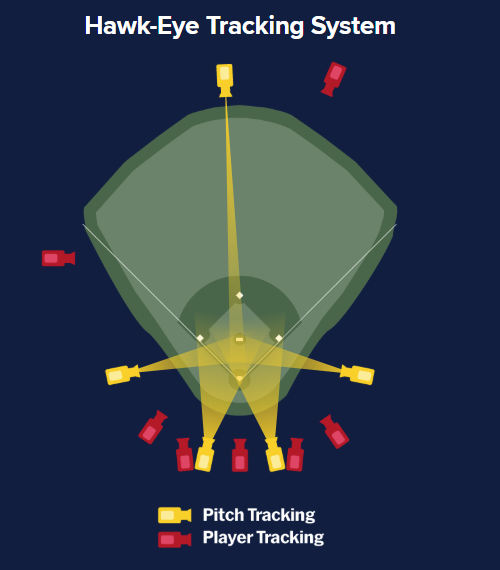
Image from https://www.mlb.com/interactive/mlb-abs-system-explainer .
In 2023, those ball‑tracking cameras were upgraded from 100 frames per second to 300 frames per second, significantly improving the system’s ability to capture spin rate, velocity, movement, and precise pitch location. This increased fidelity allows ABS to determine whether a pitch passes through the strike zone with pinpoint precision.
The Blue Jays’ Experience with ABS
The Blue Jays encountered the Hawk‑Eye‑based ABS system early, taking their first live reps during Spring Training in February 2026 as players adjusted to both the technology and the strategy behind its use. Since then, several moments have illustrated how automated strike calling affects real games. George Springer has spoken publicly about how ABS gives hitters more control over key pitches, while also forcing careful judgment about when a challenge is worth using. Vladimir Guerrero Jr. has been involved in some of the team’s most visible early challenges, including unsuccessful ones that demonstrated how unforgiving a precisely defined, camera‑based strike zone can be. From the mound, Kevin Gausman has noted that the most striking effect of ABS is not the technology itself, but the immediacy of fan reaction when Hawk‑Eye graphics confirm or overturn a call in real-time.
Intellectual Property Takeaways
From an intellectual property perspective, MLB’s use of Hawk‑Eye and ABS illustrates several important themes:
- Innovation is cumulative and multi‑actor, rather than the product of a single breakthrough invention.
- Early patent filings may retain strategic value even where they do not mature into granted rights.
- Competitive advantage often derives from a combination of patents, proprietary implementation, and operational know‑how.
MLB does not publicly attribute specific patents to its ABS deployment. Instead, the system operates within a mature and competitive technological landscape shaped by decades of development in optical tracking, visualisation, and real‑time data processing.
Conclusion
Automated strike calling can feel like a sudden change to fans watching today’s games. In reality, MLB’s Hawk‑Eye‑based ABS system reflects more than two decades of technological refinement driven by early research, subsequent patenting activity, and disciplined intellectual property strategy.
On World Intellectual Property Day, the automated strike zone serves as a reminder that innovation is rarely about a single invention. It is about building durable systems that quietly reshape how decisions are made. In modern baseball, enhanced vision is no longer metaphorical. It is engineered, protected, and deployed at scale.

/Passle/6130aaa9400fb30e400b709a/MediaLibrary/Images/2026-10-21-11-59-19-999-6ad8a9179207ce3b4702378c.png)
/Passle/6130aaa9400fb30e400b709a/SearchServiceImages/2026-10-16-11-15-18-770-6ad20746ee7a454c2dbe1b59.jpg)
/Passle/6130aaa9400fb30e400b709a/SearchServiceImages/2026-10-19-09-02-38-478-6ad5dcaee0594699cc5db2d7.jpg)