
On 25 November 2014, astronaut Barry Wilmore reached into a machine aboard the International Space Station (ISS) and pulled out a small plastic faceplate. The first object ever manufactured in space, produced from a digital design file sent from Earth. An ordinary-looking piece of hardware, but with significant implications. The experiment was a collaboration between NASA Marshall Space Flight Center (MSFC) and spacetech company Made in Space (now RedWire Space) that designed and built the printer. “This first print is the initial step toward providing an on-demand machine shop capability away from Earth,” said Niki Werkheiser, NASA’s project manager for the ISS 3D printer at the time.
3D printing has been used aboard the ISS since that moment, when NASA sent the first 3D printer to the station to test whether additive manufacturing could work in microgravity. Since then, simple plastic tools and parts have given way to metal-printing trials and bioprinting research.
If astronauts previously needed a tool or spare part, it had to be sent from Earth. Resupply launches are expensive and not suited to longer missions. Additive manufacturing changes that. Required items can be produced on demand using raw materials and digital designs already stored on the ISS, giving crews greater flexibility and cutting dependence on resupply.
Proof of Concept
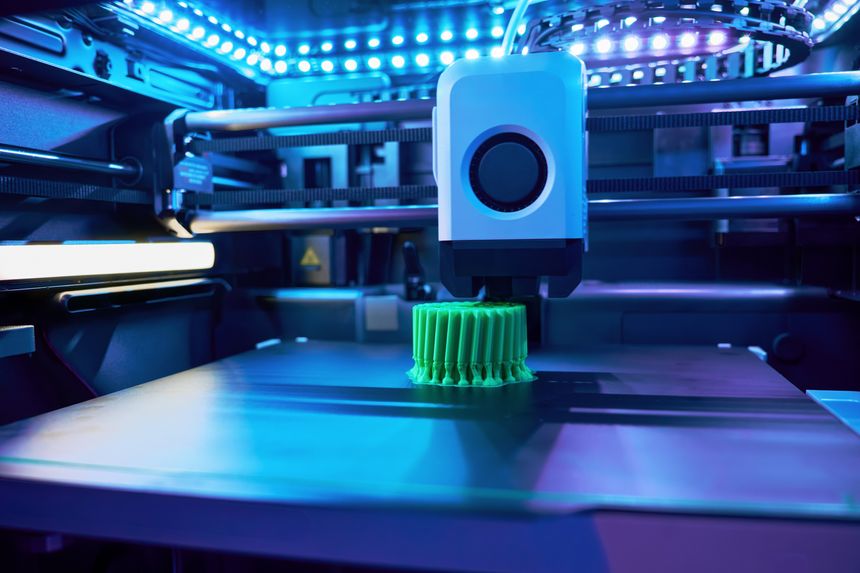
The first 3D printer was installed on the ISS as part of NASA’s in-space manufacturing efforts, led through the MSFC. The goal was to find out whether a familiar Earth-based printing process could work in microgravity. The process used was fused filament fabrication (FFF), in which a plastic filament is heated and extruded through a nozzle to build an object layer by layer.
On Earth, FFF operates under thermal and flow conditions that do not exist in microgravity. Engineers needed to know whether deposition, bonding, and final part properties would hold up. Early tests showed that they did. While some differences in density and mechanical properties were noted, later testing attributed these to process variations rather than microgravity itself, confirming the process worked normally in space.
The faceplate was a fitting first object as it was a replacement component for the printhead extruder on the printer itself, proof that the machine could make parts for its own operation. Weeks later, the engineering team on the ground heard Wilmore mention he could use a ratchet wrench. They transmitted a design file to the ISS and printed one within hours. No waiting for a resupply mission. Just a design file and a printer.
That changed the concept of inventory in space. Rather than depending on spare parts launched from Earth, crews could begin to rely on raw materials and digital design files that could be turned into useful items as needed.
Moving Beyond Plastics
Plastic was a natural starting point, simpler and safer to work with than other materials, but it has clear structural limits. Many spacecraft components need to be stronger or more heat-resistant than plastic can provide. That drove the next phase of development into more advanced materials like metal.
Metal printing in space is a different challenge, involving higher temperatures and more stringent safety requirements, and is especially harder in the closed environment of a space station. The European Space Agency's (ESA) first metal 3D printer arrived at the ISS in January 2024, and by September of that year the ESA had announced that the first metal part had been successfully printed. The part was produced using a laser-based process in which a stainless steel wire was continuously fed into a high-powered laser and melted layer by layer. To address the challenges of metal printing in space, the printer is sealed to contain heat and prevent fumes from escaping and flushed with nitrogen to prevent the hot steel from oxidising.
The manufacturing process and analysis of the first metal parts printed in space is covered in detail in a separate piece by my colleagues Susan Bradley and Yun-Hang Cho.
Metal printing is a different discipline from plastic FFF. Future missions will need repair components and structural parts for larger systems that cannot be easily shipped from Earth. While metal components are not yet being routinely produced in space missions, metal printing in space moves the field beyond plastic objects and towards stronger, more functional parts.
Researchers are also looking at recycled materials, such as polyethylene-based films and foams processed into printing filaments, and also regolith as feedstock. Regolith is the loose surface soil and debris found on rocky celestial bodies such as Earth, the Moon, and Mars. In 2021, in partnership with RedWire Space, NASA MSFC launched new print heads and materials to the ISS to demonstrate 3D printing using a lunar regolith simulant, a synthetic version of Moon dust. The printed samples were returned to Earth for analysis with ground control samples. Using lunar materials for construction on the Moon would support NASA’s long-term goal of establishing a sustained human presence there.
These efforts reduce dependence on Earth-supplied inventories and move space missions towards greater self-sufficiency. But not all the innovation has been about physical materials, as the same additive manufacturing principle can also be applied in biology.
Bioprinting in Space
Bioprinting works with living cells and supporting materials to build tissue-like structures. It is still experimental, but space seems well suited to it because of microgravity. On Earth, soft biological structures tend to collapse under their own weight during printing, and they require scaffolding to hold their shape. In microgravity, cells can aggregate and self-organise more freely, without the gravitational forces that cause uneven settling in Earth-based printing. The result is more complex tissue samples, cultured aboard the ISS and returned to Earth for medical research.
Bioprinting on the ISS began in 2018, when Roscosmos launched Organ.Aut, the first 3D bioprinter to reach the station. Early experiments in December of that year included work on animal and human tissue samples. In 2019 the BioFabrication Facility bioprinter, developed with NASA support, arrived and conducted experiments including work on cardiac tissue structures. In 2023 the first fully successful bioprinting of a human knee meniscus in space was announced.
These samples are not ready for medical use yet and the field is still in its early stages, but the work now spans advanced materials engineering and biomedical research.
Why 3D Printing in Space Matters
The history of 3D printing in space has been a decade of practical innovation, from the 2014 proof of concept to printing plastic and metal parts and bioprinting research.
But the core value has not changed. It helps astronauts make what they need, when they need it. Everything sent into orbit is expensive, spacecraft have limited storage, and resupply missions need time and planning. These constraints will only become more severe for future human missions to the Moon or even to Mars. As Werkheiser put it in the early days of the programme, “The further we get from Earth, the more important it is that we have the capabilities to design and make what we need, because you can't rely on constant resupply missions.”
By reducing reliance on resupply and giving crews greater flexibility, 3D printing is reshaping what future space exploration looks like. Getting to space is only half the journey. What matters just as much is sustainability and being able to work and build once we are there. Additive manufacturing helps crews build in space, but it is also changing how space hardware is designed and tested on Earth before launch.
3D Printing in Singapore for Space
What happens when 3D-printed hardware made on Earth is sent into space? Can it survive launch dynamics and the vacuum, radiation, and extreme thermal conditions? Singapore is helping answer those questions.
On 30 July 2023, a 23kg microsatellite named VELOX-AM, developed by Nanyang Technological University (NTU) in collaboration with the Agency for Science, Technology and Research (A*STAR), was launched into low-Earth orbit to evaluate how additive manufacturing can be used in satellite components. VELOX-AM carries 3D-printed components, including a main structure panel and an antenna, to test how they withstand the rigours of launch and spaceflight.
One of VELOX-AM’s payloads is a 3D-printed housing for a phase change material, a substance that cycles between liquid and solid to absorb and release heat, used in satellites for passive thermal control. VELOX-AM also tested advanced materials built for the harsher conditions of space. In particular, a composite of shape memory polyimide (SMPI) and 3D graphene foam (3D-C), was deployed to evaluate its performance in orbit. With a glass transition temperature of 226°C and thermal stability marked by only 5% weight loss at 500°C, the 3D-C/SMPI composite shows strong potential for future satellites and other deployable space systems.
The VELOX-AM mission demonstrated both 3D-printed components and novel composite materials in space. The long-term goal behind this satellite programme is a certifiable process for lightweight, additively manufactured satellite parts that are ready for deployment in space.
Singapore’s contribution is modest in scale but clear in direction. With the newly established National Space Agency of Singapore, Singapore continues to develop the local space sector and position itself as a credible contributor to the global space ecosystem.
3D Printed Singaporean Art in Space
Singapore’s role in space-related additive manufacturing is not limited to engineering. It has also found expression in art and culture. Singaporean artist, architect and designer Lakshmi Mohanbabu created the 3D-printed Structure & Reflectance cube, one of a hundred miniature artworks selected for the Moon Gallery cultural installation, which is tentatively set to land on the Moon no later than 2026.
Earlier iterations explored different metal materials for the cube, including Inconel and stainless steel, before the design shifted from material choice to controlling the material itself. Using laser powder bed fusion, crystals with different reflectance were formed within the printed metal by controlling crystal orientation during manufacturing. The visual effect thus emerged from the material itself, rather than from added surface decoration.
Structure & Reflectance is a work of art that also demonstrates the precision of 3D metal printing and surface engineering. Described as “a unifying message of an integrated world, making it a quintessential signature of humankind on the Moon”, the cube does not simply use 3D printing as a production method; it uses 3D printing as the artistic medium itself. It is a marriage of art and technology, symbolising that 3D printing can help humanity build in space while also becoming a medium for human expression there.
If you have a new idea or technology in the field, we have a dedicated 3D printing team who can help you develop your intellectual property strategy and protect your invention, as well as our Aerospace & Space Technologies team. For a further resource on 3D printing, please see our whitepaper: From design to download - IP protection in the age of 3D Printing.
Singapore’s strengths in advanced manufacturing, aerospace, micro-electronics, precision engineering and artificial intelligence position us well to capture new opportunities in the space technology sector.

/Passle/6130aaa9400fb30e400b709a/SearchServiceImages/2026-03-24-11-50-14-823-69c27a76ee2a9b041575cf70.jpg)
/Passle/6130aaa9400fb30e400b709a/SearchServiceImages/2026-03-19-16-31-17-625-69bc24d58863aa22076d740d.jpg)
/Passle/6130aaa9400fb30e400b709a/SearchServiceImages/2026-03-11-15-55-54-366-69b1908a16246e5d37819a7a.jpg)