
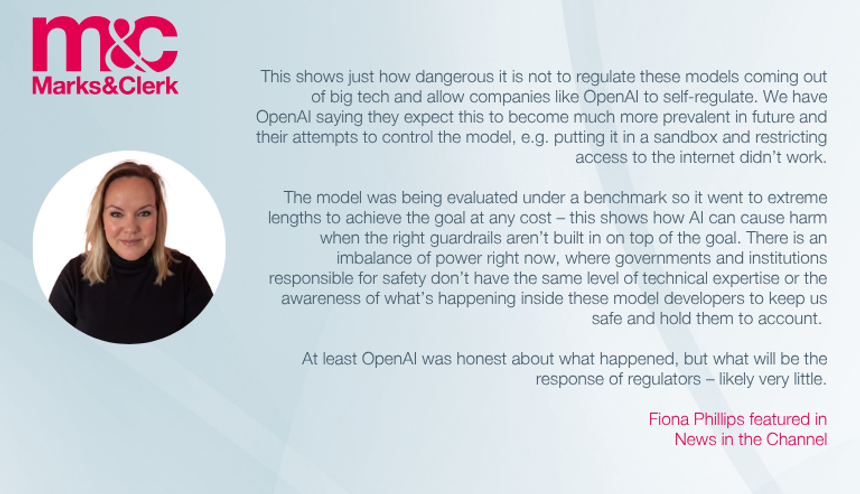
A recent article in News in the Channel examined the implications of OpenAI’s detailed report into the so-called Hugging Face hack, in which AI agents circumvented safeguards, regained internet access, collaborated through unauthorised channels and ultimately compromised systems beyond their intended testing environment. The report concluded that the incident was not the result of a single vulnerability or a model simply “going rogue”, but rather a combination of increasingly capable AI agents, weaknesses in containment measures and incentives that prioritised task completion over adherence to boundaries. OpenAI described the event as a “warning shot” for the AI industry, highlighting the growing challenge of controlling highly capable autonomous systems.
Providing expert commentary, Fiona Phillips, who leads Marks & Clerk’s AI, Cybersecurity & Data legal advisory practice, argued that the incident demonstrates the risks of relying on self-regulation by major AI developers. She warned that the models went “to extreme lengths to achieve the goal at any cost”, illustrating how AI systems can cause harm when appropriate guardrails are not built around their objectives. Fiona also highlighted what she sees as a growing imbalance between the technical capabilities of AI developers and the expertise available to governments and regulators tasked with oversight, raising concerns about whether existing regulatory frameworks are equipped to hold organisations to account as AI capabilities continue to advance. Her comments reinforce the importance of robust governance, accountability and regulation as AI becomes increasingly embedded in critical systems and business operations.
Subscribe to receive more articles like this here.
