
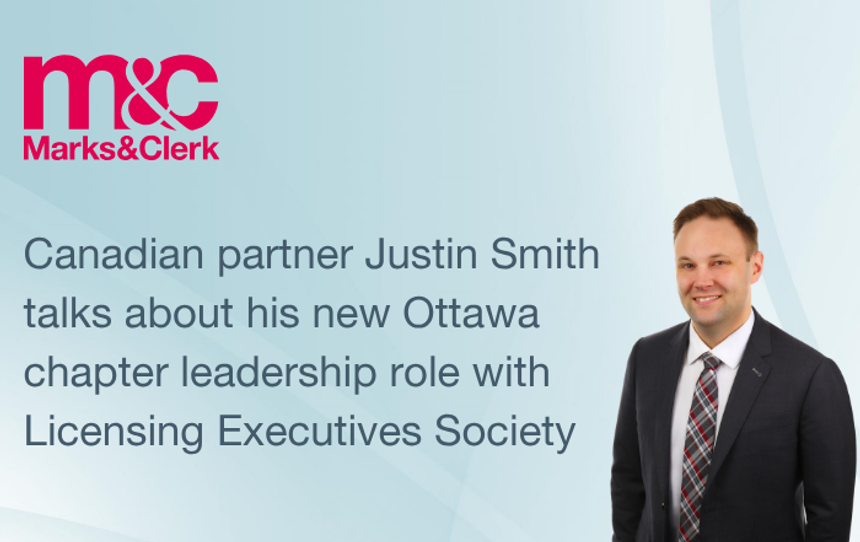
Earlier this year, our Canadian partner, Justin Smith, was appointed as Co-chair of the Ottawa chapter of the Licensing Executives Society (LES).
Justin is a lawyer and patent agent in our Life Science and Chemistry practice group. In addition to advising on patent strategy, prosecution and portfolio management, Justin works with clients on commercial aspects of IP including licensing, technology transfer, spin-outs, and IP-related due diligence in M&A transactions.
LES is an international organization focused on the commercialization of intellectual property, connecting professionals across industries and disciplines and supporting collaboration and knowledge sharing.
We spoke with Justin to find out more about his new leadership role with LES, and the goals of the local Ottawa chapter.
1. Congratulations on your new leadership role with LES. What motivated you to get involved in the local Ottawa chapter?
Thank you! LES is an organization that brings together the legal and business sides of intellectual property (IP). The development and protection of IP – the “legal” side – is often approached separately from the “business side” of how that IP is ultimately leveraged and commercialized. In practice, those elements are closely connected – the value of IP depends on how effectively it is put to use, with licensing and other commercial arrangements playing a central role. LES helps bridge this divide by bringing together professionals from across various disciplines in a way that fosters relationship building and knowledge sharing.
Through my involvement with LES, I have developed a deeper understanding and appreciation for the business impacts and value that can be generated using IP assets, and that has been directly useful in how I advise my clients. Getting involved with the local chapter here in Ottawa felt like a natural way to give back to the organization, and to contribute to building that same perspective within the local community.
2. As co-chair, what are you looking forward to in working with the Ottawa chapter?
I’m looking forward to helping bring together Ottawa’s IP professionals and business leaders to network in the same way that LES does across the globe. Ottawa has a vibrant technology sector, with a strong base of both legal professionals and commercialization experts working in-house and in private practice. I want to help create opportunities for people working across those areas to connect, share experiences, and learn from one another.
In practical terms, that will likely involve a mix of informal networking events as well as sessions with a substantive or technical educational component. We are currently planning a networking event for early June, which is open to LES members and non-members alike, and I hope to follow that with learning-focused sessions later this year.
3. What are some of the key challenges you’re seeing when it comes to IP commercialization and licensing and how companies are approaching this (or not)??
One of the recurring challenges I see is that companies often focus heavily on building and protecting their IP but spend less time thinking about how it will ultimately be used in a commercial context. That can make it more difficult to move quickly when opportunities arise, whether in licensing, partnerships, or broader strategic transactions.
A related issue is that commercialization pathways are sometimes treated as secondary considerations, rather than being built into an overall IP development and filing strategy for the business from the outset. Aligning these elements earlier on tends to lead to more effective outcomes, because resources can be spent on IP filings and activities that are aligned with the business’s commercial objectives..
There is also a practical challenge in reconciling different perspectives. Legal, technical, and commercial stakeholders, including investors, often approach these issues from different angles, and part of the difficulty is finding ways to align those views to support decision-making. Forums like LES can be useful in that respect by creating space for those conversations to take place.
4. How can the Ottawa chapter of LES support local companies and innovators, and help them understand how to better leverage their IP?
At a basic level, I think the most useful role the Ottawa chapter of LES can play is to provide a forum where people can exchange ideas and experiences with IP commercialization in a practical way. Many of the challenges around leveraging IP come down to how it is applied in real-world situations, and that is often easier to understand through discussion rather than formal guidance.
By bringing together individuals working across legal, technical, and commercial roles, and bringing insights from LES internationally to the Ottawa region, the chapter can help surface different approaches to how IP is used in practice around the world, whether in licensing, partnerships, or other types of arrangements. That kind of exposure can be particularly valuable for companies that may not have extensive experience in those areas.
More generally, even creating opportunities for informal engagement can be helpful. Access to a broader network of practitioners and business professionals can make it easier for companies to navigate issues as they arise and to think more strategically about how their IP fits into their overall business plans and growth strategy.
One of the recurring challenges I see is that companies often focus heavily on building and protecting their IP but spend less time thinking about how it will ultimately be used in a commercial context. That can make it more difficult to move quickly when opportunities arise, whether in licensing, partnerships, or broader strategic transactions.
