
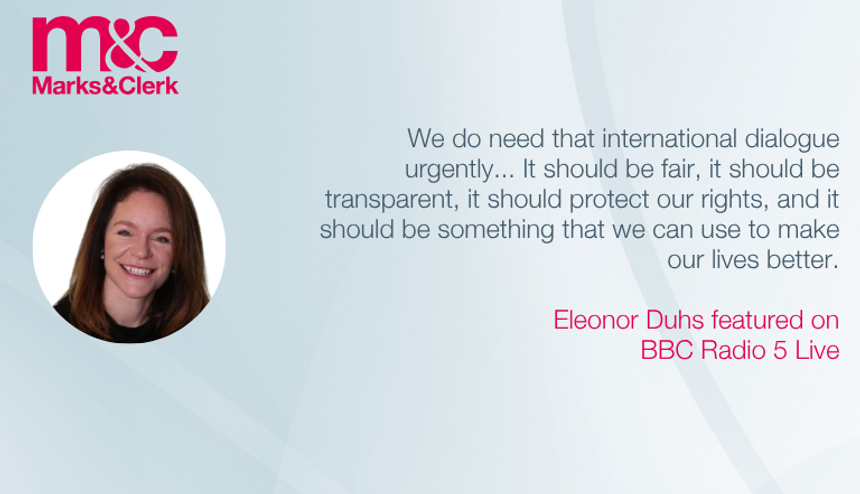
Marks & Clerk's Eleonor Duhs, barrister and data protection expert, joined BBC Radio 5 Live to discuss the rapid development of artificial intelligence, the challenges it presents for policymakers and organisations, and why she remains optimistic about the future of AI governance.
Speaking to presenter Kathryn Stanczyszyn, Eleonor reflected on the extraordinary pace at which AI technology has evolved, describing it as feeling "a little bit like a tsunami" because of the sheer volume of developments taking place across sectors and jurisdictions.
Drawing on her experience advising organisations on data protection and emerging technologies, Eleonor highlighted growing concerns about how AI systems are being deployed in ways that directly affect individuals.
She pointed to examples such as AI-driven workforce monitoring systems and AI-powered support tools for vulnerable users, noting that organisations can be so focused on adopting new technology that they fail to properly assess the risks and potential impact on the people affected by its decisions.
"People are rushing to get this technology without really thinking about how it is going to affect the individuals who are subject to its decisions," she explained.
Throughout the interview, Eleonor emphasised that AI itself is not the problem. Rather, the challenge lies in ensuring that organisations deploy it responsibly and in accordance with existing legal and ethical frameworks.
While public discussion often focuses on whether entirely new regulation is required, Eleonor explained that while there are undoubtedly regulatory gaps, important legal safeguards already exist. Data protection law, for example, contains principles around fairness, transparency and accountability that are highly relevant to many AI applications today.
However, she noted that many organisations still struggle to understand how these obligations should be applied in practice.
"We definitely do have laws which apply," she explained. "What we're seeing is that people don't really understand the law. It's pretty complex. There's a lot of risk assessment to do."
Eleonor stressed the importance of stepping back from the technology itself and considering broader questions around human impact.
"Is this fair to do to somebody? Have I explained to them what I'm doing? Is it transparent?" she asked. "All of those principles are really important."
The interview also explored how AI is becoming embedded in everyday life, from workplace tools to consumer products and online services. Eleonor noted that many people are unaware of the extent to which personal information can be used to train and improve AI systems, underlining the need for greater public understanding of how data is collected and used.
As discussion turned to the future, Eleonor argued that addressing AI-related risks will require international cooperation. She pointed to the Council of Europe's AI Framework Convention as an important step towards establishing shared global standards and principles.
According to Eleonor, the foundation for effective regulation already exists. The key challenge now is ensuring that governments, regulators and industry work together to implement it.
"AI needs to be accurate. It needs to be secure. It needs to be accountable and transparent," she said. "We need to understand how it's working."
Importantly, Eleonor rejected the idea that society should simply accept AI's development as an unstoppable force beyond human control. While acknowledging the scale and speed of technological change, she argued that governments, businesses and individuals all have a role to play in shaping how AI develops and how it is used.
Closing the interview on an optimistic note, Eleonor expressed confidence that meaningful progress is possible if policymakers, industry and society work together. While the challenges are significant, she believes the growing focus on AI governance is encouraging and reflects a shared recognition that innovation must be accompanied by responsibility.
"I am hopeful," she said. "Everyone's sitting up and listening. The world is not a particularly stable place at the moment, but it hasn't been before, and we've still managed to find ways to work together. I think we really need to do that with this technology."
Her message was ultimately one of cautious optimism. Rather than viewing AI as something that happens to us, Eleonor emphasised that people still have the ability, and responsibility, to influence its direction. Through sensible regulation, international cooperation and a commitment to fairness and transparency, she believes AI can be developed in a way that benefits society while protecting the rights and interests of individuals.
Subscribe to receive more articles like this here.

/Passle/6130aaa9400fb30e400b709a/SearchServiceImages/2026-10-08-09-16-14-047-6ac75f5e6e2df5357ce24fc9.jpg)
/Passle/6130aaa9400fb30e400b709a/SearchServiceImages/2026-10-08-08-54-19-301-6ac75a3bd24614eebffad63d.jpg)
/Passle/6130aaa9400fb30e400b709a/SearchServiceImages/2026-10-08-09-03-22-078-6ac75c5aef19e2775edf9165.jpg)