
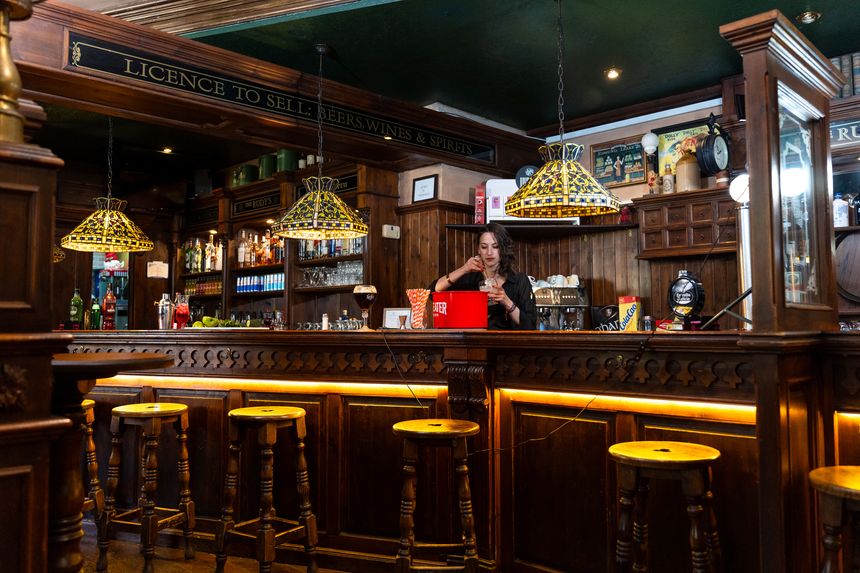
Reports that Lidl has opened a pub in Northern Ireland under the name “The Middle Ale” have attracted the sort of publicity that most marketing teams would envy. It’s an unusual story - a supermarket operator moving into pub services, using a name that immediately calls to mind one of the most familiar features of the Lidl shopping experience.
There is, of course, a licensing backstory. Lidl’s decision to open a pub appears to have been shaped by Northern Ireland’s restrictive alcohol licensing regime, under which obtaining permission for alcohol sales is not as straightforward as simply adding an off-licence section to a supermarket. The pub format, with associated off-sales rights, seems to have provided a route through that local regulatory framework. It’s an interesting commercial and licensing story in its own right, but it’s not the focus of this short piece. Lidl has turned a regulatory workaround into a branded customer experience, and the more interesting consideration is why it works at all.
“The Middle Ale” only works because customers already understand the reference. Lidl has built a public association around the experience of browsing the central promotional area of its stores. Consumers recognise it not merely as shelving, but as a retail ritual. It’s the place where unexpected purchases are found and where the brand’s personality is expressed. In shifting that idea into the pub context, Lidl is doing something more sophisticated than launching a novelty bar. It’s converting accumulated customer recognition into a new commercial setting.
This serves as a useful reminder for brand owners. Trade mark value does not always sit neatly in the obvious assets such as the company name, the logo, the core product marks and the main advertising straplines. In practice, distinctiveness often develops around a wider set of signs and behaviours. These may include colour combinations, store layouts, product ranges, recurring phrases, loyalty mechanics, packaging conventions, digital assets and consumer habits. Some will be registrable as trade marks and may have considerable commercial value.
This is where a good IP strategy should be proactive rather than administrative. It isn’t enough to maintain a portfolio of registrations. Businesses should regularly ask which parts of their brand real world customers actually recognise. The answer may reveal protectable assets that have not yet been properly captured.
Lidl is already associated with one of the most significant recent UK supermarket brand disputes. In its litigation with Tesco over Clubcard Prices signage, the courts considered the power of Lidl’s visual brand cues and the reputation attached to them. The case underlined that trade mark law is not confined to identical copying of names. Where a sign has a reputation, the legal analysis may focus on whether a later sign brings the earlier mark to mind, whether an advantage is being taken, and whether that advantage is unfair.
The Middle Ale presents a different issue, but offers the same broad lesson that brand recognition can travel. A sign, phrase or visual idea may begin in one commercial context and later become useful in another. The challenge is to ensure that the legal protection travels with it.
For clients, this matters particularly when moving into a new sector. A retailer opening a pub is not simply doing more retail. It is entering a different trade environment, with different competitors, different customer expectations and different regulatory risks. A clearance exercise should therefore look beyond the existing core registrations. It should consider the proposed name, the pub services, any off-sales, alcoholic drinks, merchandise, promotional materials, online use and possible future expansion.
The Nice classification system can sometimes encourage false comfort. A business may have strong protection in one class and assume that this is enough, but brand extensions often cut across classes. The practical question is not “what do we already own?” but “what are we now about to do?”
There is also a timing point because the best time to consider trade mark protection is before publicity begins. Once a launch is announced, the brand starts to generate goodwill, but it also becomes visible to third parties. That can invite conflict, imitation or defensive filings. Early clearance and filing will rarely be the most exciting part of a marketing project, but it may be the step that preserves the value created by that project.
The story also shows the importance of tone. Some brands can stretch because they have developed a recognisable voice. Others are more constrained. Lidl’s pub name works because it borrows from the supermarket’s existing personality without simply calling the venue “Lidl Pub”. It signals a connection, but gives the new venture its own identity. That is often the most effective form of brand extension, being close enough to benefit from existing recognition, but distinct enough to stand as an asset in its own right.
There is a reputational dimension to consider. Moving from supermarket shelves to licensed premises changes the customer experience. Staff conduct, venue management, signage, social media reaction and customer behaviour all become part of the brand environment. Trade marks can protect the name, but they cannot guarantee that the new use will strengthen the brand. That requires operational control as well as legal protection.
The practical message for businesses is clear. First, identify the brand cues that customers genuinely associate with you. Secondly, assess whether those cues are protected, protectable or at least worth evidencing. Thirdly, when entering a new category, review the trade mark position against the actual commercial activity, not just the historic business model. Finally, treat brand extension as both a marketing exercise and an IP exercise.
Lidl’s pub may prove to be a curiosity, a local solution or a wider signal of brand experimentation. Either way, it is a timely reminder that modern brands are not static. They move between products, services, physical spaces and consumer experiences. The law can support that movement, but only where the business has recognised what it owns, what it is creating and where the next point of risk may arise.
Subscribe to receive more articles like this here.
Named The Middle Ale in a play on the chain's famous middle aisle, the company is adamant this is not a stunt.

/Passle/6130aaa9400fb30e400b709a/SearchServiceImages/2026-10-16-11-15-18-770-6ad20746ee7a454c2dbe1b59.jpg)
/Passle/6130aaa9400fb30e400b709a/SearchServiceImages/2026-10-19-09-02-38-478-6ad5dcaee0594699cc5db2d7.jpg)
/Passle/6130aaa9400fb30e400b709a/SearchServiceImages/2026-10-16-13-28-09-937-6ad22669de6b66bfe10f1be3.jpg)