
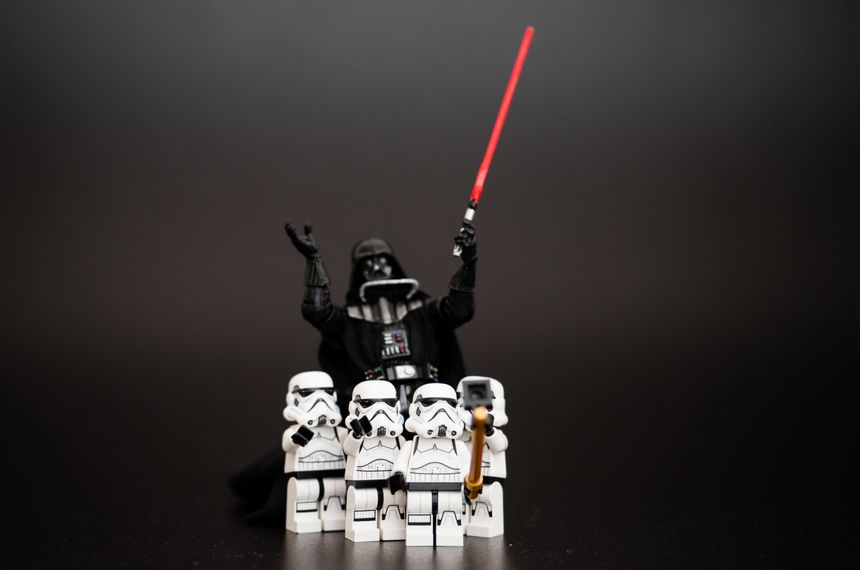
“May the Fourth” isn’t a nerdy calendar joke. Ok, maybe it is — but it is also more than that. It’s also a quiet celebration of one of the most successful exercises in intellectual property strategy ever implemented — in this galaxy, or another galaxy far, far away.
From the perspective of this IP lawyer (who also happens to be a Star Wars nerd), Star Wars isn’t just a film franchise. It’s a masterclass in how copyright, trademarks, and licensing can convert creative expression into decades of durable commercial value—long after the opening crawl fades to black.
Copyright: The (IP) Force That Started It All
At the core, Star Wars is protected by copyright: the films, scripts, characters, music, artwork, and fictional universe itself. That bundle of rights made it legally possible to control reproduction, adaptations, and derivative works—meaning that every lightsaber toy, animated series, or spin‑off game starts with permission (and a license).
Without copyright, there is no galaxy to monetize. Just a free‑for‑all in Mos Eisley.
Trademarks: Trust, Recognition, and Merchandising Muscle
Then come the trademarks. STAR WARS, character names, logos, slogans—these marks do the heavy lifting in commerce. The term “STAR WARS” itself is covered by several Canadian trademarks, either alone or in combination with specific fonts/designs or terms (including trademark TMA292266 for “STAR WARS” in association with, amongst other things, “Entertainment services, namely distribution and exhibition of motion picture film and television film and video tape”). Trademarks tell consumers that a product is authentic, authorized, and part of the canon (or at least Disney‑approved canon). It also means that revenue generated from the sale of the official licensed merchandise flows to the legal owners (and hopefully the content creators) rather than funding knock-offs produced by unauthorized third-parties that do not return any revenue to the legitimate rights holders.
Trademarks are why a plastic brick shaped like Darth Vader (Canadian trademark TMA319417) can command a premium while a look‑alike villain named “Dark Helmet Guy” cannot (interestingly, while Dark Helmet is not separately trademarked in Canada, its associated parody franchise Spaceballs is TMA750645). It is also the reason that not all “laser swords” are Lightsabers (Canadian trademark TMA583186 for LIGHTSABER)
Licensing: Turning Lore into LEGO, Video Games, T-shirts, Housewares and more
Licensing is where IP stops being abstract law and starts printing money. Video games, clothing, collectibles, theme parks—and, amongst the favourites in my household, LEGO, can leverage the Star Wars brand, characters and plot lines. It is very satisfying to have the opportunity to build my own X-Wing starfighter (Canadian trademark TMA566264 for X-WING) and recreate the Death Star (Canadian trademark TMA291127) trench battle in my basement with my family. It would not have the same nostalgic feeling to build a generic space fighter plane and attack a big, spherical space station.
The LEGO Star Wars line is a near‑perfect example of IP leverage: copyright enables use of characters and scenes; trademarks protect brand integrity of both companies; contractual licensing terms allocate risk, quality control, and revenue. LEGO has also embraced this partnership and promotes its own “May the Fourth” sales and events, which this year are related to promoting the ships and characters from the Mandalorian (Canadian trademark TMA1236652) and Grogu (Canadian trademark application no. 2449281)
Result? Billions in sales, decades of relevance, and an entire generation that learned the Force one brick at a time.
The IP Lesson (No Midi‑chlorians Required)
The enduring commercial success of Star Wars isn’t accidental. It’s the outcome of disciplined IP protection, careful licensing, and long‑term strategic thinking. Creativity launched the franchise—but IP law sustained it. While some commentators question the current lineup of Star Wars media content (see This May The Fourth, Disney’s Star Wars Is In A Bad Place, With One Exception), there is no denying the cultural impact and ongoing commercial value of the Star Wars brand.
If you’re building a brand, developing technology, or commercializing creative work, the IP lesson is simple: own the rights, control the use, and license wisely.
Call to Action
If you want your ideas to have a longer life than Alderaan—and preferably a better ending—now is the time to think strategically about your intellectual property.
May the IP be with you.

/Passle/6130aaa9400fb30e400b709a/SearchServiceImages/2026-10-13-13-25-19-174-6ace313f215a8c2ff54838bb.jpg)
/Passle/6130aaa9400fb30e400b709a/SearchServiceImages/2026-10-13-10-36-01-063-6ace09918209d8ca98299005.jpg)
/Passle/6130aaa9400fb30e400b709a/MediaLibrary/Images/2026-10-08-08-39-07-272-6ac756abfb51287ac227462a.png)