
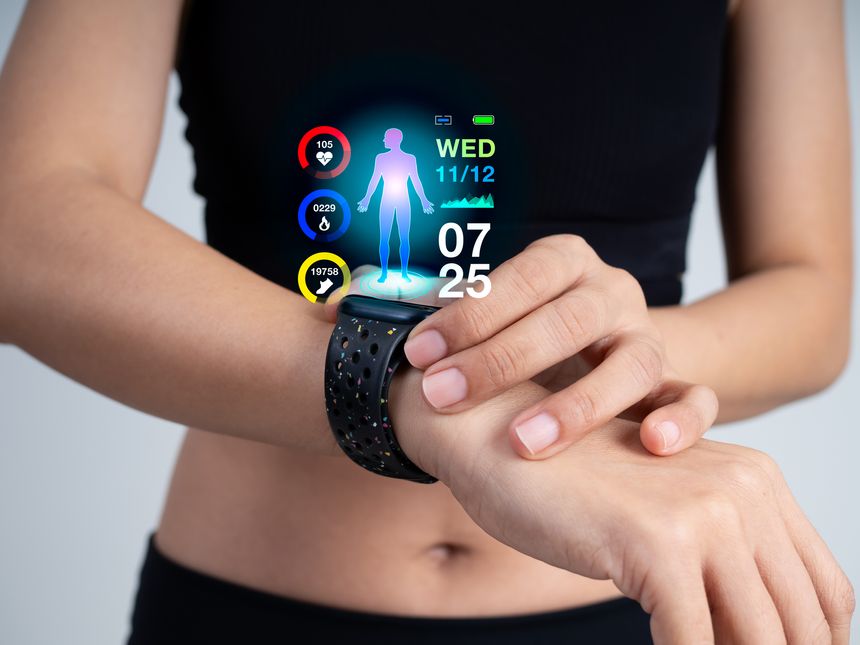
Fitness wearables and the data they provide are developing at a rapid rate. Readily available to consumers currently are trackers which can provide recovery, strain, sleep, skin temperature, resting heart rate and respiratory heart rate, all in convenient wearable accessories (and in some cases, all in one convenient accessory).
Recent IP publications appear to show the next generation of fitness wearables are moving towards tracking muscle oxygen levels (or SmO2/muscle oxygen saturation levels). In each case, companies appear to now be focusing on the inclusion of near-infrared spectroscopy (NIRS) sensors within devices to measure chemical composition or oxygenation levels in tissue.
Looking firstly at recent trademark filings from Garmin, a first for “Muscle Battery” describes an algorithm built around SmO2 data for consumer wearables. A second trademark filing for “CIRQA” relates to screenless recovery bands, which appears to include a NIRS sensor.
Further, a recently granted patent for Whoop (US 12,594,037 B2) relates to a wearable optical device for detecting muscle oxygenation, haemoglobin concentrations, and related tissue parameters. The optical core is standard continuous-wave NIRS: two narrow-band LEDs at approximately 660nm and 855nm, arranged as a point source, with a linear array of three to four photodetectors at graded distances from 5mm to 50mm. Reflectance intensity is fitted against distance to derive SmO2, oxygenated haemoglobin, deoxygenated haemoglobin, and total haemoglobin. Interestingly, this is the same broad technique used by every existing consumer muscle oxygen sensor. Therefore, in the current market, the optical architecture itself may be considered unremarkable.
The differentiator may be that the device includes pressure and tension sensors embedded in the strap itself, using both solid-state and liquid-state technologies, including PDMS-based electrofluidic circuits. The system detects strap tightness, maps pressure distribution, compares current readings to historical values, and flags when pressure is high enough to restrict blood flow or distort the tissue beneath the sensor.
Why is SmO2 Data Important?
Tracking muscle oxygen levels is crucial for athletes and coaches because it provides real-time data on the balance between oxygen supply and consumption. Accurate and interpretable data can help to:
- Optimise Training Intensity (Smarter Training): helping athletes identify their optimal training zones (aerobic vs. anaerobic) in real time. When muscle oxygenation drops low (e.g., 20-40% saturation), it indicates that muscles are using oxygen faster than it is being delivered, triggering anaerobic metabolism. This helps athletes manage their efforts and stay in the right zone to maximize training benefits.
- Preventing Fatigue and Avoiding "Hitting the Wall": By monitoring SmO2, athletes can see when their muscles are reaching a point of extreme fatigue before exhaustion causes a dramatic reduction in pace. This allows them to adjust their pace (reduce intensity) to prevent premature fatigue.
- Precision Recovery Tracking: Muscle oxygen data reveals how quickly muscles recover between sets or intervals. A rapid return of SmO2 to baseline levels indicates readiness for the next high-intensity set, allowing for tailored recovery periods.
- Replacement for Invasive Lactate Testing: Research shows that muscle oxygen sensors can provide a non-invasive, cost-effective alternative to blood lactate testing to determine anaerobic thresholds in the field.
- Performance Monitoring and Training Adaptation: Long-term tracking shows how effectively an athlete's body is adapting to training. Improved performance is reflected in better oxygen utilization by the muscles.
- Reduced Influence of External Factors: Unlike heart rate, which can be easily elevated by stress, caffeine, or heat, muscle oxygen saturation is less affected by these external factors, providing a more reliable, direct marker of internal muscle load.
Therefore, given the value of this data in training, tracking SmO2 is of great value in endurance sports (for managing pacing and avoiding athletes hitting ‘the wall’ during cycling, running, swimming or rowing events, for example); resistance training (to help determine when muscles are ready for the next set during strength training); and, rehabilitation (helping physiotherapists ensure that the correct muscles are being engaged and that rehab intensity is appropriate).
The Problems with SmO2 Data
As will be appreciated, tracking of SmO2 data could be a huge step forward for fitness wearables. Given its value, many companies have tried previously to provide wearables which track this data – with these attempts unfortunately being unsuccessful for the most part.
Interestingly, it is likely the case that SmO2 data trackers have previously been unsuccessful because the data is genuinely hard to interpret, with provision of easily digestible data providing a huge challenge in the market.
Therefore, the challenge Whoop and Garmin may be looking to solve is the translation of raw muscle oxygenation into a metric that ordinary athletes can easily act on.
Therefore, if the problem of providing genuinely useful and interpretable data for consumers from SmO2 sensors can be solved, it could be a huge step forward in the fitness wearables market.

/Passle/6130aaa9400fb30e400b709a/SearchServiceImages/2026-10-13-13-25-19-174-6ace313f215a8c2ff54838bb.jpg)
/Passle/6130aaa9400fb30e400b709a/SearchServiceImages/2026-10-13-10-36-01-063-6ace09918209d8ca98299005.jpg)
/Passle/6130aaa9400fb30e400b709a/MediaLibrary/Images/2026-10-08-08-39-07-272-6ac756abfb51287ac227462a.png)