
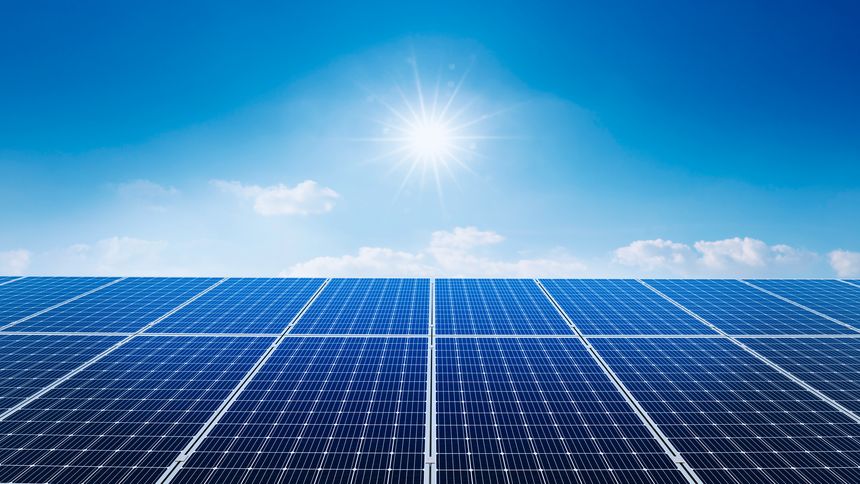
In recent years, solar power has become a key part of the transition to a green economy, and to decarbonising the energy that we each rely on every day. The rate of installation of solar power increases year-on-year, outstripping almost all predictions along the way, and the price per GW of solar power production has dropped precipitously. For example, the cost per watt produced by installing solar panels has dropped by well over 90% in the last decade, and it is expected that the price of solar power will continue to reduce as greater and greater capacity comes online.1
At this point, many complain that solar panels inevitably have costs associated with them. They may be installed in large areas of farmland, with concerns being raised about the knock-on effects on agricultural production.2 Others will point out that the solar panels themselves require the use of rare earth minerals, elements that are difficult and frequently toxic to produce, and that there are acute geopolitical tensions around the supply and demand of these materials.3
It is less well known that the efficiency of standard solar panels tops out at about 20% — for every 5 watts of power provided by the sun to the solar panel, our best technology is only able to convert 1 watt into usable electricity — the rest largely being lost as heat. The silver bullet to many of these issues would be to be able to generate more power from each solar panel, either by retrofitting those already installed or by increasing the power output from newly installed units.
Step forward Cambridge Photon Technology (CPT), one of a raft of new, green-focussed spin-outs from Cambridge University. CPT has developed a photon-multiplying film to convert unusable, high energy photons into infrared photons, which are then absorbed by the solar panel. The film can be applied on top of any existing solar panel, or installed as an additional layer in new panels, so best practice for the manufacture of solar panels need not be lost. Most impressively, tests have shown the film can increase the efficiency of the solar panels by up to 15%. (For those interested, their patent is here).
CPT has recently raised just over £1.5 million in pre-series A funding, split between industry and government partners, showing broad confidence in the team and their work, as well as an understanding of the size of the clean-energy market over the coming decades.4 The next goal is to move from the controlled environment of Research and Development testing to scaled trials. CPT intends to bring the film to market by 2028, and predicts potential savings by 2040 of the equivalent of 60 Mega-tons of CO2, approximately equal to the total annual emissions of Austria.5
Maybe more power from every panel is the future of solar? As fellow residents of this one planet, let us hope so.
- https://ourworldindata.org/cheap-renewables-growth
- https://www.bbc.co.uk/news/articles/c0kp40ky8j4o
- https://www.solarpowerworldonline.com/2025/10/could-we-run-out-of-critical-minerals-for-solar-panel-production/
- https://www.cambridgephoton.com/cambridge-photon-technology-secures-1-56m-to-accelerate-world-first-solar-breakthrough/
- https://ourworldindata.org/co2/country/united-states?country=GRC~GBR#what-are-the-country-s-annual-co2-emissions

/Passle/6130aaa9400fb30e400b709a/SearchServiceImages/2026-04-09-14-16-49-395-69d7b4d18614c88cffdc5368.jpg)
/Passle/6130aaa9400fb30e400b709a/SearchServiceImages/2026-04-09-12-38-49-770-69d79dd92952f1d4f47109a1.jpg)
/Passle/6130aaa9400fb30e400b709a/MediaLibrary/Images/2026-04-07-13-45-21-168-69d50a71e50d418cb2c70c65.png)