
In January 2024, the European Space Agency (ESA) launched the first metal 3D printer to the International Space Station (ISS).
ESA astronaut Andreas Mogensen installed the ~180 kg Metal 3D printer in the European Draw Rack Mark II in ESA’s Columbus module.
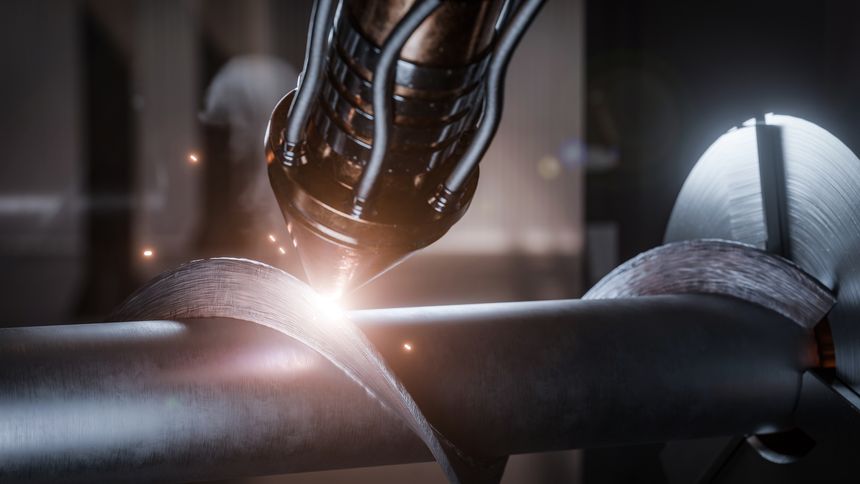
The 3D printer uses the Wire Laser Directed Energy Deposition method, a necessity given the micro-gravity environment of Low Earth Orbit. This low-gravity environment prevents the use of metal powder methods as the metallic powders would float around instead of lying at the base of the bed. A wire-based printing technology is independent of gravity. The higher power laser heats a substrate to create a melt pool where the metal wire is inserted and melted. As the laser moves, the pool of molten metal cools and solidifies, leaving a layer of 2D lines that can be stacked to create 3D components. The melt pool of the print process is very small, just several millimeters across, so the liquid metal’s surface tension holds it securely in place, even in a weightless environment.
While the process of 3D printing has been mastered on Earth, printing metal in space presents its own set of technical challenges.
The melting point of metal alloys compatible with this process can be over 1,200°C compared to around 200°C for plastic, which implies drastic thermal control and containment, especially in an enclosed environment with nearby oxygen tanks. This ensures that the fumes never reaches the crew on the ISS.
In this manufacturing process, the printing atmosphere must be flushed with nitrogen to prevent the hot metal from oxidizing in response to the oxygen.
The latest developments continue the goal of 3D printing in space which first began in 2016 with Made in Space (Redwire)'s plastic 3D printer. Later efforts included the Italian space agency ASI's POP3D printer which demonstrated the lower power requirements of a fused filament fabrication process using PLA polymers. In 2018, NASA's Refabricator sought to recycle plastic materials with a machine that accepts plastic materials of various sizes and shapes to turn them into the feedstock for 3D printers.
The new metallic samples will be examined using microscopes to inspect the surface and X-rays (CT scan) to see beneath the surface of the parts and into the internal structures.
Just like the labs that many undergraduate mechanical engineering students will no doubt find familiar, the bone-shaped samples are then pulled in a tension test to analyse the tensile strength. Unlike a typical first year lab at university, the samples are specked with luminescent paint so that as the samples deform, the speckle pattern also deforms, allowing the mechanical deformation to be tracked.
Do you want to 3D print something in space? Perhaps you have a new idea or technology? We have a dedicated 3D printing team who can help you develop your intellectual property strategy and protect your invention, as well as an Aerospace & Space Technologies team.
For further information on 3D printing, please see our whitepaper: From design to download - IP protection in the age of 3D Printing.
"For a materials engineer, getting to inspect the very first metal object 3D-printed in space is both thrilling and inspiring" Caterina Iantaffi, ESA’s materials engineer


/Passle/6130aaa9400fb30e400b709a/SearchServiceImages/2026-03-31-13-16-59-814-69cbc94b3500b48c6b0bb858.jpg)
/Passle/6130aaa9400fb30e400b709a/SearchServiceImages/2026-03-25-04-59-43-215-69c36bbfe81277fde9a40bf9.jpg)
/Passle/6130aaa9400fb30e400b709a/SearchServiceImages/2026-03-30-09-41-31-861-69ca454b2a7335329c11003a.jpg)