
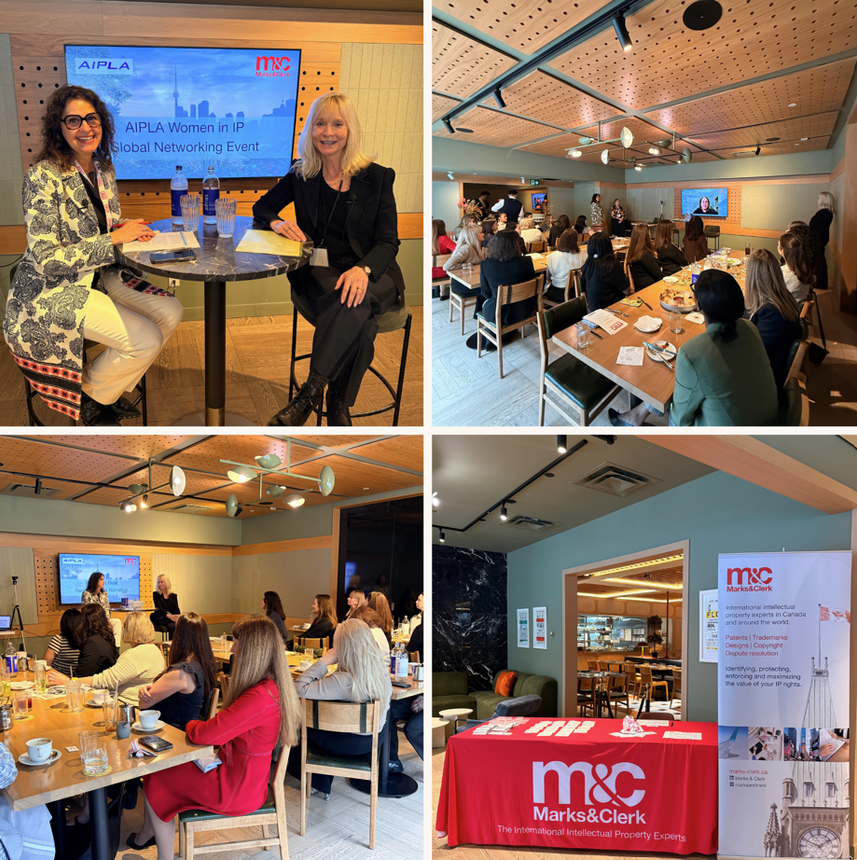
Last Thursday, the Marks & Clerk’s team in Canada hosted the American Intellectual Property Law Association (AIPLA) Women in IP Global Networking Event, in Toronto.
This year’s theme was Rooted in Real: Redefining the Narrative which we explored through a Fireside Chat with Kamleh Nicola, Partner and Co-head of Litigation and Dispute Resolution, and our special guest Judith McKay, Principal and Founder of JEM3 Consulting and former IP Lawyer and General Counsel, among other roles.
The event brought together 30 women in the IP community for an insightful and candid discussion on a wide range of topics from personal branding, professional confidence and authenticity, and leadership in the practice of intellectual property law. The conversation resonated deeply, offering both practical guidance and a refreshing reframing of some common myths and misconceptions in professional development.
Beyond Being “A Good Lawyer”
The discussion opened with a fundamental question: Is it enough to simply be a “good lawyer”? The resounding answer was no. Being a top-notch lawyer or IP practitioner is the starting point, not the endpoint.
In a profession filled with highly experienced practitioners, we discussed the importance of developing your personal brand and how to cultivate it. Attendees were encouraged to consider this from multiple angles: what unique skills do you bring? Which perspectives or experiences shape your approach? How do you “show up” for clients, colleagues, and your broader professional community? What are your personal and professional values?
Developing a personal brand allows you to be able to communicate who you are, what you stand for, and how that can help your clients.
Rethinking “Authenticity”
The conversation turned to authenticity, a word often used, and over-used. We discussed what it means to be authentic and the idea of “aspirational authenticity”.
For women in professional settings, it can sometimes be hard to be truly authentic to who you are in every situation. We may not always feel confident or comfortable sharing who we are. That’s where aspiring to be authentic can be a good starting point by tapping into the vision we have of our best self. Importantly, when you show up with authenticity it should feel consistent, credible, and human, and ultimately should reflect who you are as a person, not just as a professional.
Putting an End to “Impostor Syndrome”
One of the most thought‑provoking moments of the event came during a discussion about “impostor syndrome.” The call to action from the speakers was clear: stop using the term altogether.
Labelling feelings of self-doubt as “impostor syndrome” can become a form of negative self‑talk that undermines confidence. Instead, the speakers encouraged participants to reframe this and to recognize these feelings simply as “the jitters” which are a common and normal experience shared by professionals at all stages.
Practical strategies were shared for how to handle moments of uncertainty, particularly before business development meetings or high‑stakes conversations:
Remind yourself why you are in the room and the accomplishments that brought you there
Ground yourself through breathing or visualization exercises to calm your nerves
Take a moment to notice your surroundings before entering a meeting and be present
Practice your personal brand messaging until it feels natural and confident
Confidence, as the speakers emphasized, is not about bravado – it’s about preparation, perspective, and permission to own your success.
Leading Authentically — and Being Led Well
Authenticity also plays a critical role in leadership. To lead a team effectively, it is essential to know the people on your team beyond their task list. Just as lawyers and IP practitioners strive to understand their clients, leaders should engage in genuine conversations with their team members. Taking time to learn about their interests, families, hobbies, and motivations will help you understand what’s important to them and make you a better leader.
Key leadership takeaways included:
Ensuring team members are seen and heard in group settings
Publicly recognizing contributions and celebrating successes
Expressing gratitude and sharing credit across the team
Being open to learn from all team members, regardless of seniority
Overall, the discussion offered thoughtful perspectives and practical insights for participants to apply throughout their professional journey.

/Passle/6130aaa9400fb30e400b709a/SearchServiceImages/2026-10-16-11-15-18-770-6ad20746ee7a454c2dbe1b59.jpg)
/Passle/6130aaa9400fb30e400b709a/SearchServiceImages/2026-10-19-09-02-38-478-6ad5dcaee0594699cc5db2d7.jpg)
/Passle/6130aaa9400fb30e400b709a/SearchServiceImages/2026-10-16-13-28-09-937-6ad22669de6b66bfe10f1be3.jpg)