
As part of our Space Tech for Good campaign, my colleagues and I at Marks & Clerk are discussing the numerous ways in which technologies originally developed for use in space are improving our everyday lives here on Earth. In this installment, I’ll be discussing an application of NASA technology that is not only improving the lives of Earthlings, but is arguably changing them entirely – for the better, of course.
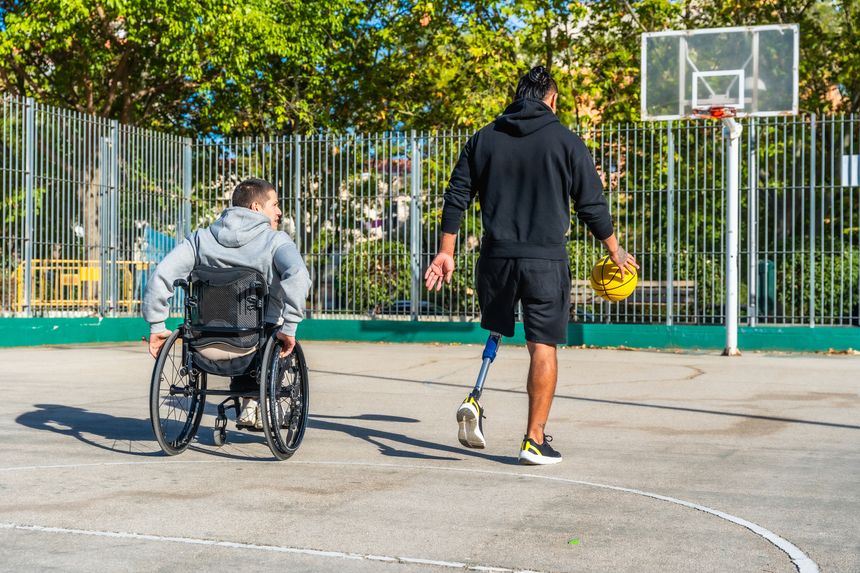
In particular, this NASA technology is bettering the lives of those inhabitants of Earth who have lost limbs, by way of its application in the manufacture of prosthetic limbs.
Our discussion begins with NASA’s famous space shuttle, and the launch system responsible for putting it into orbit. In fact, our discussion begins with the largest component of this launch system, no less – the space shuttle’s external tank (ET). During launch and ascent, the ET served as the space shuttle’s backbone, connecting its solid rocket boosters (SRBs) with the orbiter itself. As if the ET didn’t have enough to do, however, it also served to store the fuel (liquid hydrogen) and the oxidiser (liquid oxygen) required to be supplied to the space shuttle’s main engines during launch. Given that the ET would have to maintain the liquid hydrogen’s cryogenic temperature whilst withstanding the high temperatures, mechanical stresses and vibrations associated with launch, NASA understood that a unique material would be required to insulate the ET; and so they produced one. Enter the ET’s highly robust specialised insulation foam.
A break now from the space sector, to discuss the manufacture of prosthetic limbs. In order to manufacture a prosthetic limb that can be effectively fitted to a patient’s residual limb, it is necessary to produce a “blank”. In short, a blank is a model of the patient’s residual limb, on the basis of which a socket can be manufactured for the ultimate purpose of connecting the patient’s replacement, prosthetic limb to their residual limb. Diverging slightly from the modelling of sockets for prosthetics, in order to produce the exoskeleton of the prosthetic limb itself, models of a patient’s sound-side (or intact) limb (where the patient is, for e.g., a unilateral amputee) are also produced. This model thus ensures that the patient’s sound-side limb and their prosthetic limb are closely matched. Traditionally, blanks and other models in the prosthetics sector were produced using a plaster cast method. That is, a mould of the patient’s residual limb, for example, was created using plaster wraps. This mould was then filled with plaster in order to create the blank or model.
Back to the space sector now, and the combined efforts of NASA’s Marshall Space Flight Center (MSFC) and The Martin Marietta Corporation (now known as the Lockheed Martin Corporation) to produce a derivative of the ET’s specialised insulation foam. This derivative was to be adaptable to industrial manufacturing whilst retaining its core protective characteristics – i.e. a derivate fit for commercial applications. The derivative produced was a significantly lightweight and structurally robust foam, capable of maintaining its strength and stability even at high temperatures. In an industrial context, therefore, this was a foam that was highly machinable.
It wasn’t long before this foam derivative replaced plaster as the preferred material from which to produce blanks and models for prosthetic limb manufacture. It is at this point in our discussion, then, that the space and prosthetic limb manufacturing sectors combine, transforming the lives of patients in a seriously positive way.
The main advantages of a foam blank or model relative to its plaster counterpart are its significantly reduced weight, its reduced production cost, its reduced production time and its increased machinability.
Today, blanks and models are generally produced using computer-aided design and manufacturing (CAD/CAM) systems. After having digitised the patient’s residual limb or their sound-side limb, a computer-directed carver shapes the foam blank into a positive model thereof. The foam blanks produced using this modern method are far more accurate to the patient’s residual or sound-side limb than any produced by way of the traditional plaster cast method. And it is this high degree of accuracy which realises an improvement in the patient’s lived experience of their prosthetic limb.
For instance, where the above manufacturing method is used to produce a positive foam blank of the patient’s residual limb, this blank can then be used as a base around which the final prosthetic socket is produced. For example, thermoplastic sheets may be thermoformed (heat and vacuum moulded) around the foam blank in order to produce the socket. Having been formed around such an accurate model of the patient’s residual limb, this prosthetic socket, and eventually the prosthetic limb attached thereto, will fit far more comfortably to the patient’s body, and will thus function far more effectively.
There you have it: the same technology, used initially to insulate the External Tank of NASA’s famous space shuttle, and subsequently in the manufacture of replacement limbs for Earth-dwelling human beings. A classic case of Space for Good.
To my patent attorney mind, this case not only highlights the benefit of R&D in the space sector to humanity overall, but also the importance of robust intellectual property protection. From at least this case, it is clear to see that the way in which a technology is applied is susceptible to vast change as the technology develops and new demands for technology arise. It is important, then, to assess from the very outset of technological development – to the best of your ability – all potential applications of an invention. Having done so, it is then important to ensure that the scope of your intellectual property protection sufficiently covers these (a process Marks & Clerk would be happy to assist with).

/Passle/6130aaa9400fb30e400b709a/SearchServiceImages/2026-03-24-11-50-14-823-69c27a76ee2a9b041575cf70.jpg)
/Passle/6130aaa9400fb30e400b709a/SearchServiceImages/2026-03-19-16-31-17-625-69bc24d58863aa22076d740d.jpg)
/Passle/6130aaa9400fb30e400b709a/SearchServiceImages/2026-03-11-15-55-54-366-69b1908a16246e5d37819a7a.jpg)