
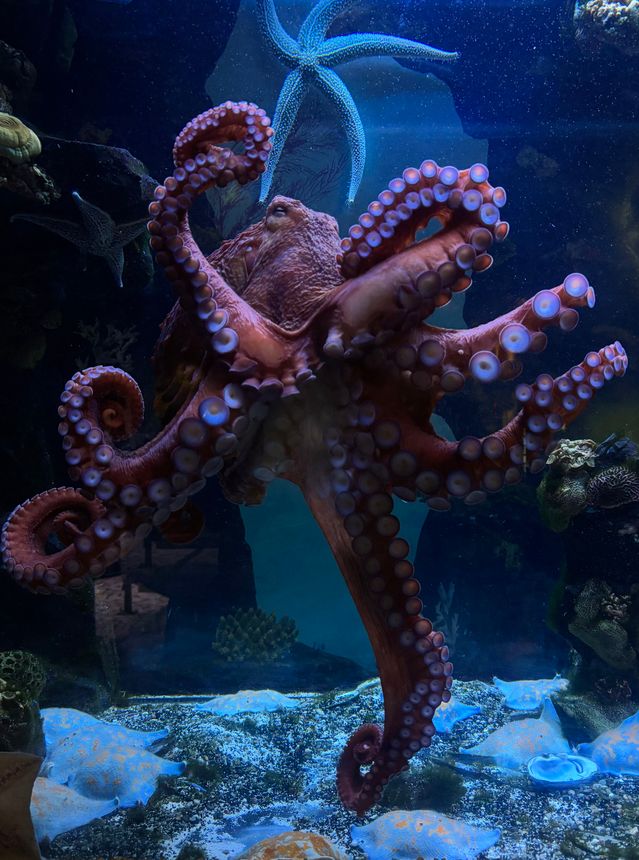
An interesting paper in Nature by researchers at Penn State University who have developed a fabrication method to print multifunctional smart synthetic skin, mimicking the way in which an octopus can control its skin colour to camouflage itself from potential predators or to communicate.
The paper presents a cephalopod‑inspired halftone‑encoded 4D printing method that enables synthetic hydrogels to dynamically modulate optical appearance, mechanical behaviour, surface texture, and 3D shape in response to external stimuli such as temperature, solvents, and mechanical stress.
Drawing inspiration from octopus and cuttlefish skin—whose chromatophores, papillae, and muscular structures allow rapid changes in colour, texture, and form—the researchers design binary hydrogel domains: highly crosslinked “1” regions and lightly crosslinked “0” regions. These domains react differently to stimuli, enabling fine-grained control over transparency, stiffness, swelling, and deformation. Spatial arrangement of these halftone patterns allows the material to encode and reveal high‑contrast images, such as the Mona Lisa, through stimulus-driven optical transitions including cononsolvency‑induced transparency shifts.
Beyond optics, the hydrogels also exhibit mechanically encoded information, where halftone‑controlled stiffness variations generate distinct strain‑mapping patterns under load, enabling multi‑layered, secure information storage. The same encoded gradients guide 2D‑to‑3D shape morphing, producing spherical caps, saddles, and textured surfaces with controlled Gaussian curvature, achieved without multilayer materials.
This platform may offer a powerful route for engineering multifunctional, programmable materials with applications in soft robotics, adaptive camouflage, flexible displays, and secure communication systems.