
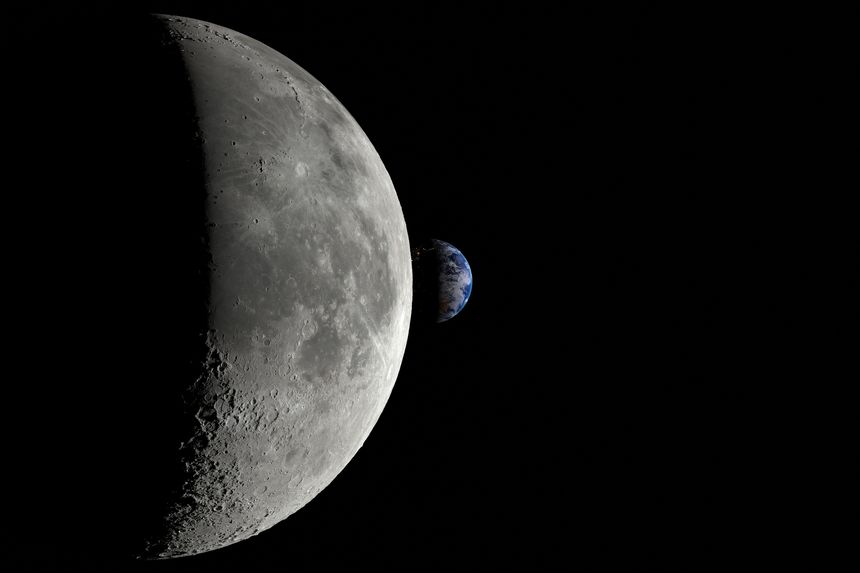
If you are reading this before the launch of NASA’s Artemis II mission, then right now US astronauts Reid Wiseman, Victor Glover, Christina Koch and Canadian astronaut Jeremy Hansen are sitting in the Orion spacecraft near the top of the Space Launch System (SLS), a 98-meter rocket, waiting for launch as early as 6:24 p.m. ET today (April 1, 2026).
The Artemis II mission is the first crewed flight to orbit the Moon in over 50 years. It paves the way for future lunar landings and tests long-duration deep space travel. It is also a major milestone for Canadian innovation.
As the Globe and Mail recently reported, Canada’s participation in Artemis II is the result of a longstanding approach of investing in high value, mission critical technology. Canadian robotics systems have repeatedly proven indispensable to international space programs. That technical credibility has translated into access, influence, and opportunity.
Canada’s Role as Partner and Innovator
Canada’s participation in Artemis II reflects decades of collaboration with NASA, from the Space Shuttle era to the International Space Station, and now to humanity’s return to the Moon. Canadian expertise in space technologies has become essential infrastructure for international missions.
A key example is Canadarm, developed by MDA Systems in Brampton, which represents decades of accumulated IP: patented mechanical systems, autonomous control software, AI algorithms, and proprietary engineering know-how.
Canada is contributing the next generation Canadarm3 robotic system to the Lunar Gateway, the planned space station that will orbit the Moon. This commitment of advanced robotics is one of the reasons a Canadian astronaut has a seat on Artemis II, underscoring how technological contributions translate directly into mission participation.
This model of technology in exchange for access, has positioned Canada as a highly valued partner in multinational space efforts.
Other Canadian technology is being used in the Artemis II mission. One example includes deep space communications technology developed by Advantech Wireless Technologies in Kirkland, Quebec, to provide communication with Orion up to 2 million kilometers away.
Launch is a New Chapter for Canadian Space Technology
Canada’s space technology model is now expanding beyond robotics and communication systems. In March 2026, the federal government announced $200 million in strategic investments to establish a Canadian-owned spaceport and advance sovereign launch capability, alongside $105 million in competitive grants to Canadian launch innovators including NordSpace, Canada Rocket Company, and Reaction Dynamics.
These government investments represent a deliberate effort to accelerate the creation of domestic space IP, from propulsion systems and launch vehicles to software, autonomy, and range safety technologies, built and operated in Canada.
From Mission Hardware to Intellectual Property Assets
Behind the robotic arms, the space sensors, and the spacecraft modules are portfolios of intellectual property: patented inventions, protected software, proprietary manufacturing processes, and confidential know how. As space missions become more collaborative, IP governance becomes more complex.
Canadian companies and research institutions contributing to space missions can and have secured their IP by filing for patents, establishing trade secret procedures, establishing licenses with partners domestically and internationally, and navigating export control. In multinational missions like Artemis, IP is a strategic asset that facilitates commercialization and partnerships.
From Strategy to Liftoff
Canada’s space strategy shows that the real force multiplier goes beyond thrust, robotics, and technology – it includes mission‑critical IP. As Artemis II’s crew stands ready for launch, we’re reminded that this moment is the product of decades of continuous human innovation, with Canada playing an increasingly vital role in enabling space exploration and the economic ecosystem that follows.
From Marks & Clerk, wishing clear skies, nominal burns and successful flight trajectories. Godspeed, Artemis II.
As a mission specialist on Artemis II, Canadian Space Agency astronaut Jeremy Hansen is set to make history. Together with his American crewmates – commander Reid Wiseman, pilot Victor Glover and mission specialist Christina Koch – Col. Hansen will spend 10 days aboard NASA’s Orion crew capsule as it loops around the moon and back.

/Passle/6130aaa9400fb30e400b709a/SearchServiceImages/2026-04-01-20-57-55-819-69cd86d3705f46f2d4c868f5.jpg)
/Passle/6130aaa9400fb30e400b709a/SearchServiceImages/2026-04-01-14-51-37-115-69cd30f92f273dfa89068159.jpg)
/Passle/6130aaa9400fb30e400b709a/MediaLibrary/Images/2026-03-31-15-29-13-751-69cbe849cb05567388004e6f.png)