
Sustaining life in outer Space is perhaps one of the most difficult tasks humanity has ever faced. There is no air, food, water or gravity, and astronauts must navigate unfamiliar light and radiation conditions.
To tackle this issue, we have built Space stations, enclosed volumes where we can create a pressurised atmosphere against the will of the universe. But with an enclosed space, means an enclosed system. Everything that we take for granted on Earth, a plentiful water supply, almost unlimited air, and sufficient land to create food, all of that must be replicated onboard a flying Space station overhead. Water places a particularly demanding requirement, after all, doctors always recommend 7-13 cups of water per day. The average human produces up to 2 litres (67.6 ounces) of urine a day. In a Space station with 6 people, this would be 4,380 litres or 4 tonnes (8820 lb).
Launching heavy supplies like water into orbit is also incredibly expensive and logistical space is limited. Without recycling, there would be insufficient water for humans in Space, and also a lot of urine to process!
On the International Space Station, an advanced “Environmental Control and Life Support System (ECLSS)” has been developed and used.
This contains three critical systems: Water Recovery System, the Air Revitalisation System and the Oxygen Generation System (NASA, 2014).
The Water Recovery System has successfully recovered 98% of all water brought onboard. This works through several highly engineered steps:
1) Collection: The system captures every drop of available moisture. This includes wastewater from hygiene tasks, urine, and even ambient cabin humidity (which is made up of astronaut sweat and exhaled breath captured by advanced dehumidifiers).
2) Urine and Brine Processing: The Urine Processor Assembly (UPA) recovers about 75% of the water from urine using a process known as vacuum distillation. By lowering the pressure, it enables the distillation to take place without excessive heating, something which uses precious energy to do. To compensate for the lack of gravity, the distillation assembly is mounted in a rotating centrifuge. The spinning forces helps to separate the liquid urine and vapourised water molecules. The remaining liquid (urine brine) is passed through a newer component called the Brine Processor Assembly (BPA), which uses special membrane technology and warm, dry air to evaporate and extract the final fraction of reclaimable water. Once the water and the brine has been separated, the water is sent to the Water Processor Assembly (WPA) for further treatment.
3) Water Processor Assembly (WPA): All recovered water (from air, hygiene, and urine) is routed to the WPA where gas and solid materials such as hair and lint are removed through a particulate filter. Then, the water is passed through a microbial check valve. The patented Microbial Check Valve (MCV), created by UMPQUA Research Company, of Myrtle Creek, Oregon, releases iodine into the water, which then kills bacteria and viruses. A proprietary resin called Iodosorb is then added, this functions as an iodine scrubber. Testing of the system demonstrates 6-log bacteria kill (99.9999 percent) and 4-log virus kill (99.99 percent), which meets U.S. Environmental Protection Agency standards and is equivalent to, if not better than, water in many industrialised countries. The water then passes through a series of specialised multi-filtration beds to remove suspended particles, salts, and organic impurities. The multi-filtration beds are designed to insure ionic breakthrough occurs before organic breakthrough. This is accomplished by providing more organic adsorbent than the corresponding expected organic load.
4) Catalytic Oxidation: The water was heated and exposed to oxygen in a catalytic reactor. This breaks down any remaining low molecular weight, polar organics, volatile organic compounds and microorganisms that slipped through the filters in the multi-filtration beds. The process water was saturated with oxygen, heated to 130oC (267oF), and passed through a catalyst to oxidise the organics to carbon dioxide and/or to ionic compounds.
5) Final Checks & Sterilisation: Before the water is provided for re-use, sensors rigorously monitor the water's quality, for example by detecting the conductivity of the water. The presence of contaminants is indicated by an increase in conductivity (pure water lacks free ions). If the sensors detect “unsavoury” water, then it is looped back through the system for reprocessing. If it passes, iodine is added to prevent microbial growth during storage. The end result is actually cleaner than most municipal tap water on Earth.
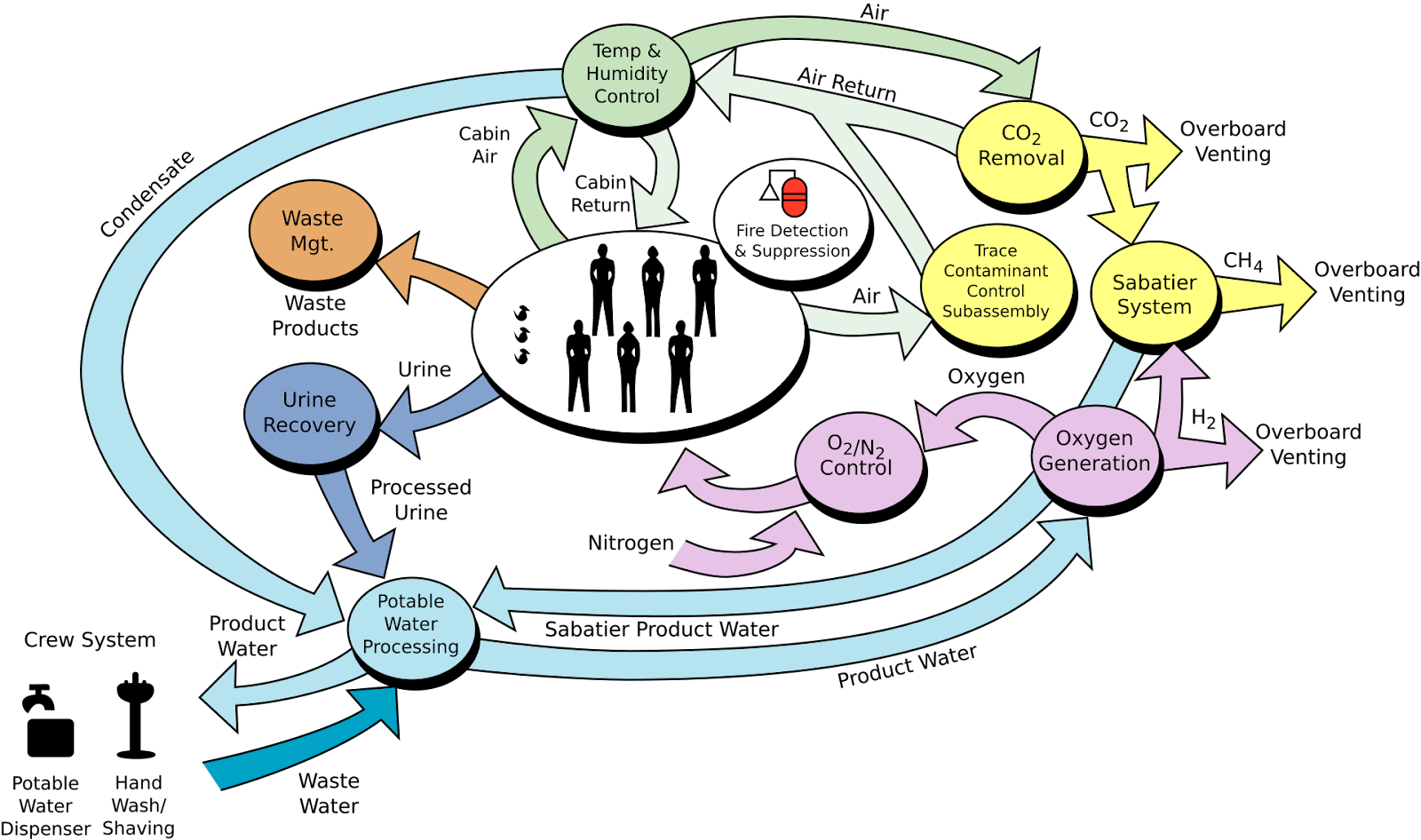 Figure 1 - Diagram showing how the different systems in the ECLSS (Environmental Control and Life Support System) are connected. Picture credit: NASA
Translating Space Tech to Earth (NASA Spinoffs)
Some of the water purification technologies developed by engineers and scientists for astronauts are now widely used in our everyday life and continue to benefit people today.
1) Nanofiltration Technology
In the early years, to physically remove bacteria and viruses, filters needed to have micropores that were small enough to physically remove bacteria and viruses. However, because the micropores were so small, it also reduced the flow rate making the process of creating clean water very slow.
Argonide Corporation later discovered a non-woven filtration media composed of nanoalumina fibres derived from mineral boehmite. The filters attract and capture viruses, bacteria and heavy metals primarily via electrostatic attraction (specifically electropositive charge) and adsorption. A single layer of this filtration media contains pores about 2 micrometers in size, yet it can remove more than 99.99 percent of particles as small as 0.025 micrometers. This filtration media is capable of removing a wide range of contaminants, including bacteria, viruses, cysts, parasites, organic debris, and both dissolved and particulate metals such as iron and lead. Since then, other companies have applied this filter in various water purification products, including water bottles, portable humanitarian units, and industrial water treatment systems.
This also led to the development of the NanoCeram water filter. In 2012, Mehrdad Mahdjoubi, a master’s student in industrial design at Lund University, developed a water filtration technology known as NanoCeram through a partnership between Lund University and NASA. NanoCeram incorporates the filter developed by Argonide.
Today, back on Earth, Orbital Systems, founded by Mehrdad Mahdjoubi, incorporates NanoCeram filtration technology into the Orbital Shower, a water-recirculating shower. Orbital showers are believed to reduce water usage by up to 90% and save energy by up to 80% through recirculating the shower water.
2) Silver Ionisation
In space, astronauts do not have access to a fresh supply of food and beverages. Therefore, they must rely on methods to preserve and purify these consumables to prevent spoilage. Silver ionisation is of particular interest to NASA because it provides a highly effective, long-lasting, and non-toxic method for water disinfection in closed-loop systems, an essential requirement for long-term space exploration.
Although the use of silver to preserve and purify food and beverages dates back to ancient times, in the 1960s, NASA built on this concept by developing an improved method using silver ions to neutralise bacteria and viruses without the use of iodine, since long-term consumption of iodine can have potential health effects on humans.
At NASA's Lyndon B. Johnson Space Center (formerly known as the Manned Spacecraft Center), a project was commissioned to develop an electrolytic silver ion generator to purify water for the Apollo missions.
While the electrolytic silver ion generator never had the chance to fly into space due to concerns over Silver getting into the air, it gave rise to many innovations on Earth.
For instance, the technology was later used to build the Bon Del and Ambassador lines of tap-water filters, and Puronics Water Systems eventually applied it to develop a water softener that helps prevent the growth of bacteria. Today, Puronics Water Systems continues to sell products incorporating this technology, called SilverShield. Many other companies also use silver ionisation technology in products such as water filtration systems for home faucets, pools, spas, boilers, hospitals, and more.
3) Aquaporin Membranes
As mentioned above, one of the challenges NASA faced in its early years was the extremely high cost of transporting water into space. Therefore, NASA has explored water purification technologies to recycle water already available in space into clean drinking water, reducing the need for frequent water resupply missions. At the time, the recycling system on the International Space Station (ISS) relied on heavy filtration beds that increased the weight of resupply missions and required replacement every 90 days. Additionally, the system was not sufficiently advanced to remove certain semi volatile contaminants, which posed potential hygiene risks for astronauts. Therefore, the need for a more efficient filtration method led NASA to explore technologies developed by Aquaporin A/S.
NASA was an early funder and the first paying customer of Aquaporin A/S. Aquaporin A/S is a Danish biotechnology company that specialises in water filtration and purification technologies by incorporating natural proteins, known as aquaporins, into filtration membranes to remove contaminants. Back then, Aquaporin A/S focused on developing water purification products using both reverse osmosis and forward osmosis technologies.
While both methods are effective, forward osmosis offers a slight advantage because it transports water without the need for external hydraulic pressure, whereas applying pressure in reverse osmosis can cause membranes to become clogged with debris. This lower tendency to clog made forward osmosis particularly appealing to NASA and was a key factor in their decision to fund Aquaporin A/S.
In 2016, Aquaporin A/S launched its first commercial product, a home-use under-sink filter module that uses reverse osmosis for water purification. Today, the company produces a variety of products using its patented Aquaporin Inside® technology, incorporating both reverse and forward osmosis. For example, their Drinking Water Reverse Osmosis series consists of drinking water reverse osmosis elements and membranes, while their Hollow Fiber Forward Osmosis technology leverages natural aquaporins and osmotic pressure to enhance water reuse and concentration processes with minimal back diffusion.
Unfortunately, on 30 January 2026, the Board of Directors of Aquaporin A/S decided to withdraw the rights issue announced on 19 December 2025 and initiate insolvency proceedings, filing for bankruptcy due to ongoing financial challenges. Despite this, Aquaporin A/S, as one of the key innovators of aquaporin-based membranes, has made a significant impact on the global water technology market. The company has promoted the natural treatment of industrial wastewater, the concentration of food and beverage products, and the improvement of drinking water quality and accessibility worldwide.
Conclusion
In conclusion, Space is a harsh environment, forcing humanity to innovate more than ever. Many of these innovations can and are re-applied back to benefit citizens of Earth. So, the next time someone mentions that government funding for Space technology should be diverted towards other things, just remember that the very water you rely on for drinking could include technologies originally developed for astronauts.
5 Space Station Live: Environmental Control and Life Support System. [Film]. NASA, Johnson, 2014.

/Passle/6130aaa9400fb30e400b709a/SearchServiceImages/2026-03-24-11-50-14-823-69c27a76ee2a9b041575cf70.jpg)
/Passle/6130aaa9400fb30e400b709a/SearchServiceImages/2026-03-19-16-31-17-625-69bc24d58863aa22076d740d.jpg)
/Passle/6130aaa9400fb30e400b709a/SearchServiceImages/2026-03-11-15-55-54-366-69b1908a16246e5d37819a7a.jpg)